January marks the anniversary of this blog, and it has become a tradition for me to use this occasion to write a post sharing insights and tips to help other academics in leveraging the power of blogging for public engagement. This year, as the blog turns fourteen, I want to look at how Generative Artificial Intelligence (Gen AI) can enhance the blogging experience for academics.

While I find blogging to be an extremely rewarding activity in itself, and an excellent mechanism to engage with various research stakeholders, there is no denying that it is a very time-consuming activity. Even if we consider that I would still be reading, reflecting and writing, as part of my professional practice, and that blogging saves me time in other activities, there is a net investment in each blog post of, at least, a couple of hours of my time. Added up, over a year, that’s a non-negligible amount of time. If Gen AI can help with parts of that process, saving time and improving quality, I think that it is worth exploring how to incorporate it in academic blogging.
Moreover, becoming familiar with Gen AI tools will help us understand its potential and limitations, so that we can better support our students in preparing for a world where these tools are ubiquitous. A friend once said, a propos of teaching digital innovation but barely using social media himself, that doctors don’t need to have cancer in order to treat against it. He is right. But, as many doctors would attest, having close experience of the disease gives you a level of understanding and empathy that is not taught in books. Likewise, experimenting with Gen AI tools will give educators and researchers a type and level of knowledge that can’t be easily absorbed from just reading about it.
Hence this blog post.
So, what exactly is Generative AI?
Gen AI is a type of artificial intelligence that can generate new outputs. For instance, it can produce new text, new images, new code, and so on. Examples of Gen AI systems include ChatGPT, Copilot, Bard, LLaMA, Midjourney and DALL-E, to name only a handful of household names which are popular as of the start of January 2024.
As with other types of AI, we still have a training dataset (e.g., articles from the New Work Times), an algorithm (for instance, a large language model) and an output (usually, generated autonomously). But, as far as I understand, the key differentiator is that, in Gen AI, each query results in the creation of a new output (for instance, a new piece of text) that is inspired by, but different from, the training data.
A key development in Gen AI, that contributed to its popularisation in the last couple of years, is that it can now recognise and use language at levels comparable to those of humans. This means that anyone that speaks that particular language (say, English), can converse with the AI system just like they would do with another human being. Thus, in principle, anyone can benefit from the impressive gains in size of AI training datasets and in processing power.

Before we look into how we can use Gen AI to support public engagement, I would like to add a few caveats:
- For the purpose of this blog post, I am looking at free Gen AI products, only. While these versions are limited in terms of features and accessibility, I think that they are the ones most relevant for anyone just beginning to dabble in Gen AI and blogging. Namely, when I talk about ChatGPT, I am referring to ChatGPT 3.5 which you can access via Open AI’s website.
- My examples are relevant for the state of these products as of 8th of January 2024. Given the money being poured into Gen AI, new features are coming up every day. I recommend that you follow Ethan Mollick’s fantastic blog for Gen AI related news, reflections and examples of applications. You can also follow him on LinkedIn. Beware: the pace of change is dizzying.
- This post looks only at the use of Gen AI to support academics who use blogging for public engagement. For an interesting discussion of its use for research, I suggest Anjana Susarla, Ram Gopal, Jason Bennett Thatcher and Suprateek Sarker’s paper “The Janus Effect of Generative AI: Charting the Path for Responsible Conduct of Scholarly Activities in Information Systems”. For examples of use in University teaching and assessment, I am finding Michelle Kassorla’s LinkedIn posts very helpful (Ethan Mollick writes about that, too). And, last but not least, Mark Schaefer sometimes writes about implications of Gen AI for marketing communications including blogging.
In the remaining of this post, I look at how Gen AI can support academic blogging across three stages:
- Idea generation – i.e., deciding the topic for each post.
- Content creation – i.e., creating the text and other content for the blog post.
- Audience engagement – i.e., ensuring that the content resonates with the intended audience.
- Idea generation
1.1. Suggest topics
Some people blog when they have something to say. Frequency may vary but, in principle, when they sit down to write something, they know exactly what they want to say. Others follow a publication pattern, to develop the “writing muscle”, and give the reader some predictability. For instance, Pat Thomson usually publishes a post on Mondays. Those of us following a regular pattern of publication will, at times, be facing the “blank page” without a definite idea of what to write about. In that case, we could prompt Gen AI chatbots for suitable topics.
As an example, I copied the last 9 months of my blog posts nto ChatGPT, Copilot and Claude.ai and asked: “Please identify the main themes of this blog and suggest 6 additional posts”.
As there is a limit of 2,000 characters in the free version of Copilot, the query only considered the last couple of weeks of posts. Thus, the suggestions were very skewed. I couldn’t really write any of the posts suggested. ChatGPT’s response was skewed by a recent post which doesn’t really fit with the theme of this blog. But, other than that, the suggestions were very much in line with my interests. In fact, I had already penned some ideas for posts related to three of the six themes suggested. Claude.AI was, in my view, the best one at abstracting from specific titles to categories of posts and offering recommendations that fitted those categories. The suggestions were all viable.
1.2. Expand ideas
Gen AI chatbots can also help expand an idea. For instance, they can suggest points that we did not initially consider; and they can also help us look at the topic from another angle.
To test this, I entered the content of the blog post “Science backed guide to gift-giving” into ChatGPT and Copilot and asked “What is this post missing?”
Once again, the character limit in Copilot’s free version was a problem because it ended up recommending things that I had already considered, like, the wrapping. ChatGPT, however, made some useful recommendations, such as considering how gift-giving customs might vary across cultures or the psychological impact of colours. If I had done this search before I wrote the post, I might have looked for research on those two aspects of gift giving and, possibly, include those tips on the blog post, too. Maybe next year?
2. Content creation
2.1. Summarise materials
A blog post is likely to relate to some other piece of content. For instance, a news article, a paper or a video. When we need to summarise the key points from that piece of content in our post, we could use the tools below, with a prompt asking the tool to create a summary:
- Copy the text onto ChatGPT or Copilot
- Upload the file to Claude.ai.
- Enter the URL for your YouTube video in summarize

You do need to be careful because the tools will make mistakes. For instance, when I asked Claude.ai to summarise the papers used in the post “Leveraging AI in Customer Interfaces: Insights from Consumer Perception Research”, the tool mixed up which type of message works best for the different types of failures (paper 3). So, while there are useful tools, they do not replace actually reading or watching the content that we want to refer to.
2.2. Structure content
Once we know what we want to write about, and the key messages, we can use Gen AI to generate the first draft. One approach is to simply ask these tools for ideas.
For the post that you are now reading, I used the prompt “I am writing a blog post to share tips to help other academics use blogging for public engagement. This post will look specifically at how academics can use generative AI in blogging. Please suggest key points that I should cover. Bullet points is fine”.
The reply was:
Key Points:
- Introduction to Generative AI: Explain what generative AI is and its potential applications.
- Benefits for Academics: Discuss how generative AI can aid academics in content creation, idea generation, and engagement.
- Examples and Use Cases: Share practical examples of how generative AI can be applied in academic blogging.
- Ethical Considerations: Highlight ethical aspects and potential challenges associated with using generative AI in academic communication.
I really liked the classification of benefits into “content creation, idea generation, and engagement” and, as you can see, I am using that structure to organise the examples and suggestions in this post. So, the ideas are still mine – but Gen AI is helping me communicate them in a more structured manner.
Alternatively, we can ask one of the Gen AI chatbots to craft paragraphs with specific parameters. For instance, for the post “Leveraging AI in Customer Interfaces: Insights from Consumer Perception Research”, I used the following prompt in Claude.ai: “The opening paragraph should be about the increasing use of AI in customer interfaces and, therefore, the importance of understanding how these interactions impact on consumers”
Here is the result:
| Claude.AI’s paragraph | My text |
| Artificial intelligence (AI) is being increasingly incorporated into customer service interactions, with chatbots, voice assistants, and other AI agents taking on frontline roles. As these conversational AI technologies become more prevalent, it’s critical that companies understand how consumers perceive and respond to them. | Artificial intelligence (AI) is revolutionizing customer interface through chatbots, voice assistants, and other conversational agents. As these technologies become more human-like in how they respond to our queries, even adapting to specific speaking styles, it becomes even more important to understand consumer perceptions and responses to these interactions. |
As you can see the final result was quite different from the initial suggestion. But, in my view, benefited from the suggestions. And, also importantly, it was easier for me to have some text to work from.
2.3. Generate images
My posts usually have some sort of image accompanying it. Most times, these are images taken from the paper that I am summarising, but they can also be a table that I created, or one of my own photos. But, sometimes, I need a new image with specific attributes. Usually, I would search for copyright-free images on platforms such as Unsplash. But, an alternative, is to use AI-generated images.
For instance, I used Wepik to create the image at the top of this blog post. I also used Gencraft to generate this image, for my project about washing machines:

2.4. Generate videos
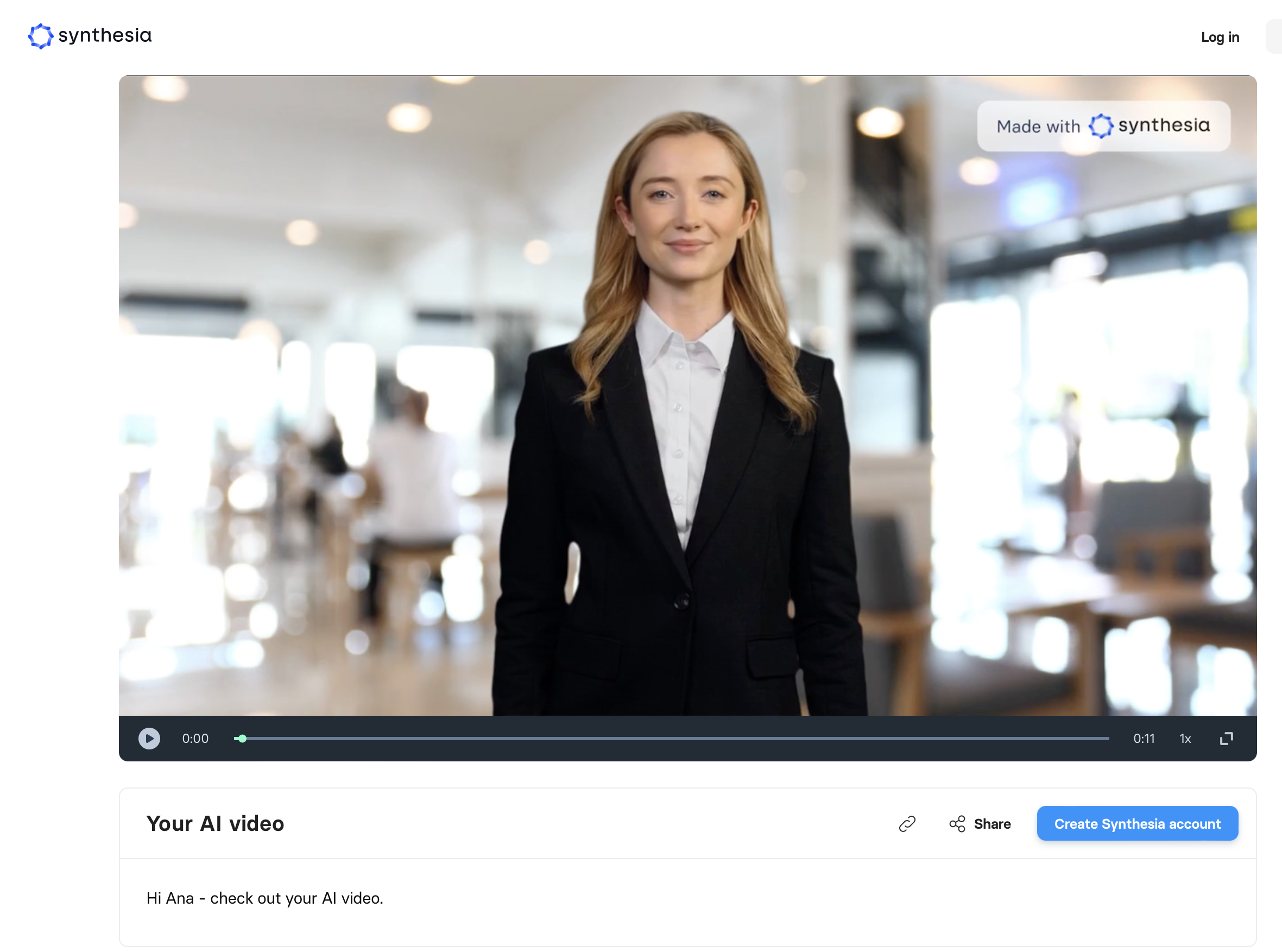
Something that I would like to do more of, is to create videos. But it is such a time consuming task that, up to now, I only made very simple videos. But Gen AI could be really helpful, here. For instance, using the free version of Synthesia, I created this video based in the introduction of the “The trend for yearly recaps” blog post:
I also used the free version of HeyGen for the same purpose. But the result is, I think, unsatisfactory:
However, with some investment of time and money, you could create something really impressive like this video by Ethan Mollick.
2.5. Generate audio
As with video, it is possible to use Gen AI to generate audio outputs. Here is one I created in ElevenLabs, based on “The trend for yearly recaps” blog post.
And here is a whole podcast episode created by Mark Schaefer.
2.6. Generate interesting titles
One of my writing weaknesses is coming up with interesting titles not just for blog posts but also for papers. Thus, something that I have been experimenting with is to upload the introduction to my article to one of Gen AI chatbots mentioned above, and ask it to give me four suggestions for titles.
For instance, my initial title for this blog post was: This blog is 14 – Potential and pitfalls of generative AI for academic blogging
But, then decided to use ChatGPT to ask for four title suggestions. It produced the following titles:
- Exploring Gen AI in Academic Blogging: An Introduction for Experts
- Gen AI Unveiled: A Beginner’s Guide to Academic Blogging Enhancement
- Gen AI for Academics: Navigating the Basics of Enhanced Blogging
- Gen AI and Academic Blogging: A Primer for Novice Explorers”
And I, eventually, went with a mix of suggestions 4 and 2: Generative AI and Academic Blogging: A Beginner’s Guide
3. Audience engagement
3.1. Creating engaging endings
If we blog for content or social reasons, rather than simply for the benefits of the process itself, we usually like to get some reaction from the readers. Usually, this is encouraged in the closing paragraph, via a statement or a question.
Unfortunately, as with titles, I have some trouble wrapping up my writing. So, I am experimenting with Gen AI chatbots to develop endings for my blog posts. As with the other aspects of content creation, I never use exactly what the tool produces. Rather, I use it as a basis from which I craft my own closing statement or question.
Here is an example of a closing question developed with Copilot, for the “The trend for yearly recaps” post: “Which of your favourite digital services would you like to get a personalised “Year in Review” from?”
3.2. Improving accessibility
Academic writing can be quite wordy and formal. These characteristics can make the writing obscure. So, once we have written a blog post, it can be a good idea to run it through one of text tools mentioned previously (Claude.ai, ChatGPT…) and ask for it to summarise the key points. If the summary fails to capture something that we wanted convey, or gets it wrong, it’s a sign that we need to edit the writing.
We can also ask these tools to replace passive with active writing, or to suggest ways to improve readility. Here is how ChatGPT suggested improving the paragraph above:
“Academic writing often tends to be verbose and formal, which may lead to obscurity. Therefore, after composing a blog post, it’s beneficial to utilize text tools like Claude.ai or ChatGPT to generate a summary of the key points. If the summary overlooks or misunderstands any crucial aspects we intended to convey, it serves as a clear indicator that the writing requires careful editing.”
3.3. Adjusting Content for Different Audiences
Last but not least, we can use Gen AI tools to help us reach new audiences.
Those aiming to reach international audiences can ask the tools to translate the text into that another language. As with other suggested uses of Gen AI mentioned, already, there will be mistakes. So, we need to take the output as a starting point, only.
We can also ask for examples of the concept that we are talking about, that make it relevant for different contexts and audiences. For this, we should use a Gen AI tool that has access to the Internet, to reduce the chance of made-up examples (i.e., hallucination). Moreover, tools using online information, such as Copilot, will often include links to the source of the example, which allows us to verify the source. One example of this feature was when I wrote the “The trend for yearly recaps” post. I asked Copilot for examples from different industries, to add to the ones that I had already: Spotify and Duolingo. Copilot suggested various that were not relevant, such as Netflix’s Year in Review, which uses aggregate data, only. However, among those, there were two that I could use: Fitbit and Goodread.
Finally, we could use these AI powered chatbots to create concise and impactful headlines, to promote the posts on social media. Just like with the title (see point 2.6 above), we would feed the post (or part of it) to the tool, and ask it to come up with suggestion for different social media platforms. Again, there will be problems. For instance, this suggestion for a Twitter / X post has more than 280 characters, which is the limit for unverified accounts:
📆✨ Unwrap the Year: Digital services like Spotify, Duolingo, and more are giving users a unique look back at their 12-month journey. 🎁📈 Discover the power of personalized data narratives and share which service you’d love a “Year in Review” from! 🚀💬 #DataNarratives #YearInReview #DigitalJourney
Copilot did not make that mistake:
“It’s that time of the year again! Digital services are offering personalised statistics about the previous 12 months of engagement with their services. Learn more about the trend for yearly recaps in our latest blog post! #yearlyrecaps #digitaltrend #personalisation”

In conclusion, Gen AI tools can be useful aids for academic blogging. Playing around with the free versions of Gen AI tools is a relatively easy way to learn more about this technology, and how it can support us in public engagement. In addition, it gives us first-hand experience of the pros and cons of Gen AI, so that we can have deeper discussions with our students about the role of these tools in their studies, assessment and professional lives.
What are your thoughts on integrating Gen AI into academic blogging, and which tool do you find most helpful?

 Ana Canhoto
Great Information Provided Thanks For The Information !
Keep Posting more!
aws institute in hyderabad
LikeLike
Thanks for sharing! Gen AI is opening up endless possibilities across industries. Generative AI Course in Hyderabad
LikeLike
Great read! The generative AI course looks like a solid way to upskill and stay ahead in the AI-driven future.
LikeLike
Great read! The generative AI course looks like a solid way to upskill and stay ahead in the AI-driven future.
LikeLike
AI Development Company
LikeLike