
Last week, Sam Altman, the CEO of Open AI, wrote a blog post entitled “The Intelligence Age”.
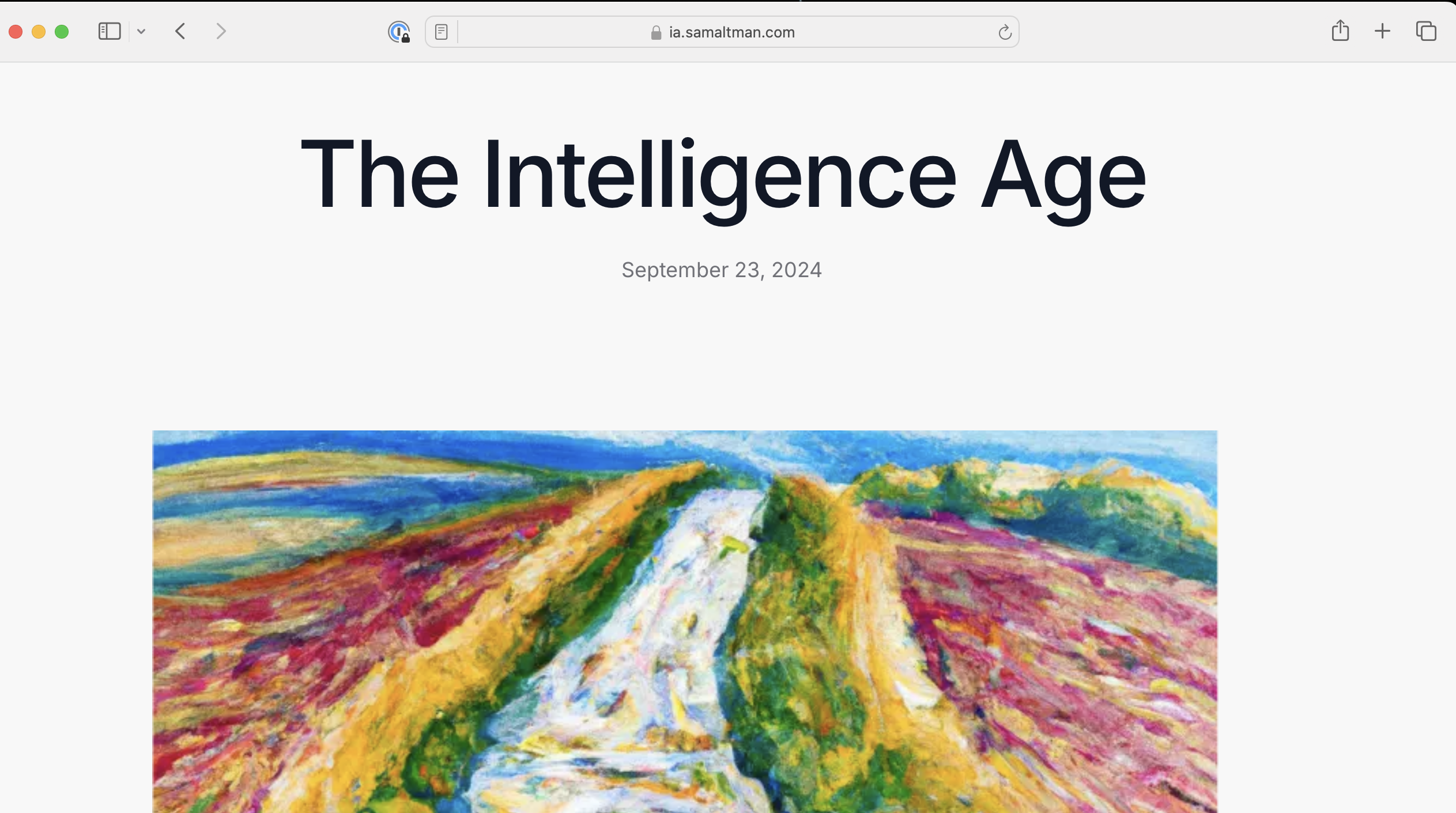
In this post, Altman foresees that “in a few thousand days[1]” we will have access to super (artificial) intelligence, which will enable each of us to “have a personal AI team, full of virtual experts in different areas, working together to create almost anything we can imagine. Our children will have virtual tutors who can provide personalized instruction in any subject, in any language, and at whatever pace they need. We can imagine similar ideas for better healthcare, the ability to create any kind of software someone can imagine, and much more”.
This super intelligence will solve global warming and establish a space colony, among others.
This world will be enabled by deep learning technology which, Altman says, can “truly learn… the underlying “rules” that produce any distribution of data”, and by having access to computing power at large scale. Altman adds that failing to achieve computing at scale risks international conflict and inequality, and notes that achieving such scale requires “lots of energy and chips”.
The irony that developing this scale of computing risks accelerating the very global warming that the technology promises to solve, and further accentuates geopolitical tensions seems lost on Altman. Still, it is interesting to see what is on Altman’s radar for the next few years.
Altman’s blog gave me a great excuse to revisit the episode of the Tell Me a Story podcast, which dramatized Mike Molesworth’s “A Heteronomous Consumer Romance” paper.
What do you think of Altman’s blog post?
[1] I am assuming that “a few” is around 3. Thus, “a few thousand days” would be around 3,000 days. or just over 8 years. Hence, the reference to 2032, in the title.

 Ana Canhoto