I started blogging on this day, 15 years ago, mostly as a means of capturing examples of marketing principles working in everyday life, and readings that were relevant for topics that I was working on. The style and frequency of blogging have changed over time, however, it remains an important part of how I share what is on my mind work-wise. Over the years, I’ve experimented with various platforms, such as YouTube or LinkedIn, to both connect with my audience and develop my ideas. Lately, I have noticed a significant number of content creators that I follow using Substack, and I decide to look into it, too.
Substack is an online platform that supports the creation and distribution of newsletters. In turn, newsletters are a type of communication whereby content is curated by a source (e.g. a news organisation or an expert on a specific topic) and delivered directly to the reader, for instance via e-mail. Newsletters are seeing a resurgence in popularity, possibly due to the fragmentation of social media. A key benefit for readers is that newsletters consolidate information, in one single place. In turn, for creators, newsletters provide a direct point of contact with their audience, as well as valuable information regarding which type of content or writing style resonates best with readers. Substack’s simple on-boarding process and monetisation options have made it popular with communicators across the board. Users choose a theme; create their content, which can include audio and video; upload their e-mail distribution list; and, voila, the post gets sent to the inboxes of people on that list. There is an option for paid subscriptions, and there are various analytics. This “get started” post provides a useful overview of how Substack works.
So, I thought that it was time to look at Substack and assess its suitability as a communication channel. To do that, I used the AIMRITE framework, which prompts us to look at communication channels through six key criteria:
- Audience
- Impact
- Message
- Response convenience
- Internal management
- The end result
This is the result of my initial assessment.
Audience: Does the medium reach the desired target audience efficiently?
Newsletters, in general, are delivered directly to readers – for instance, via e-mail subscription. In the UK and EU, we need permission to send newsletters to people’s inboxes. This means that, by and large, Substack content will only reach people that know about us, already, and who clicked on the subscribe button.
I say, by and large, because there is always the possibility that some readers will forward the newsletter to someone. Moreover, Substack features some newsletters on their website, too. Thus, it is always possible to reach people that had never heard about us before.
Despite the possibility of reaching new audiences, I would say that, overall, we should think of Substack as a channel for reaching audiences that already know about us. If that is your goal, then Substack could be a very good option. But, if you are aiming to reach new audiences, then you will need to rethink.
Impact: Does the medium ensure that the message gets through the clutter?
When we use a newsletter, the message is delivered straight to people’s inboxes. Moreover, it will remain there until it is read or deleted. So, the chances of the message getting through the clutter and actually being “consumed” are much better than for content posted on social media, where it is at the mercy of algorithms, and the ever-refreshing feed.
Non-paying subscribers may, at times, perceive the newsletter as spam, even if they signed-up for it, and end up deleting it without reading. I, for one, do not read all newsletters that I signed-up for. Moreover, it is not clear to me whether Substack newsletters fare any better than blogposts delivered via e-mail or RSS feeds.
However, overall, I would say that content shared via Substack should perform well on the impact dimension, particularly for paid subscribers.
Message: Does the medium support the clear communication of the message?
Newsletters can be very creative media. Substack, in particular, seems to provide good flexibility in terms of format, allowing content creators to experiment with different ways of communicating their message, and to create engaging content for different types of audience. Substack also has a mobile app for iOS and Android, meaning that the content should also work well in mobile formats.

Though, in my view, Substack has limited customisation options vis a vis other providers or blogging platforms. So, it may not be a good option for people or organisations that need a lot of control over their branding.
Convenient Response: Does the medium make responding easy?
When we share a piece of content, we usually expect some sort of response. This could be getting feedback about the idea (e.g., do you prefer A or B), getting new information to help the idea develop further (e.g., replying to a survey or posting in the comments), sharing the content with somebody else to help the idea spread further, or complete an action such as downloading a report or sign-in up for an event, among many others.
In newsletters, in general, it is possible and fairly easy for readers to reply to questions and perform simple calls to action such as forwarding the newsletter to their acquaintances, following a hyperlink on the newsletter, completing a quiz, or so on. However, usually, they are not a good means for creating community, because communication is mostly between the sender and the reader.
Having said that, Substack does have a chat option which supports interactions between newsletter subscribers:
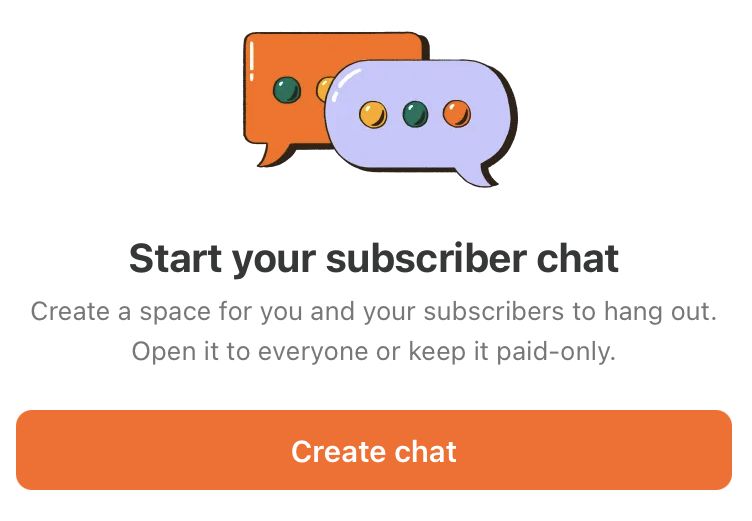
So, it seems that Substack is a good medium for different types of responses. Moreover, the analytics’ option could help us understand which prompts work better for different types of action.
Internal management: Can the client and its suppliers capably manage the medium?
A key challenge with newsletters is that they are difficult to manage. We need to build and create a suitable list of contacts, handle issues related to readers’ opting-in to receiving the newsletter, keep the list updated and ensure data protection. Substack famously had a big failure to protect its users’ privacy, when it included all their e-mail addresses in the c/c field of an e-mail.
We also need to assemble the content and format the newsletter. Substack interface is fairly easy to use, including options for collecting money from subscribers and tracking conversion from social media ads. It also seems fairly easy to import content from WordPress, Medium and other platforms, though I have not tried this option.
However, hosting content on Substack is always using “rented space”. We are at the mercy of the owners’ decisions regarding features, pricing, what content is allowed, etc… And while Substack has a reputation for high quality content, it also has some problems with controlling hate speech in its platform. Moreover, it had some problems raising additional investment, even if its numbers continue to grow.
Thus, Substack provides a fairly users friendly platform. But it is important that we do not underestimate the risks and challenges of using it; and that we consider it as part of a portfolio of means of communicating with our audience – not the only one.
The End Result: Do the estimated costs per response justify using this medium?
As should be clear from my comments in the previous post, the cost of running a Substack newsletter goes well beyond the subscription fee (if we decide to use the additional features available via the paid version). Whether the expense and the overall cost are worth it or not really depends on what we are trying to achieve with our communication efforts.
Is your goal to test the waters of newsletter subscription? Then, Substack looks like a low-friction way to give that a go. Or is your goal to cut through the clutter and deliver highly relevant content to a highly engaged audience of paid subscribers? Substack may be the way to go, and you can always move on to a proprietary platform, later, if granted. For other uses, the business case may not be so clear.
Are you using Substack? I’d love to hear about your experience.

 Ana Canhoto