
A new report from the OECD sheds light on how more than 5,000 small and medium-sized enterprises (SMEs) across seven countries (Austria, Canada, Germany, Ireland, Japan, Korea, and the UK) are engaging with generative AI. This is an important report because while SMEs form the backbone of most economies, much of the of the discussion about AI adoption focuses on big corporations.
I recommend checking the report, here; and watching this presentation and discussion organised by Digit. But, in the meantime, here are some highlights that caught my attention.
Who is using generative AI and how
Adoption of generative AI increases with company size and is most common in the services sector. Still, use cases appear across all industries, showing how widely applicable the technology is.
For now, most SMEs are using generative AI for text generation and for simple, infrequent, peripheral tasks such as drafting documents, handling emails or marketing copy. These uses make everyday operations easier but do not transform the business itself.

However, there is one interesting outlier: In Korea, SMEs use generative AI for core activities such as developing new products and services.
The key benefits derived from using generative AI
The top benefit reported by SMEs using generative AI is improved employee performance (65%), followed by the ability to scale up (35%), compete with larger firms (29%), and increase revenue (26%).

The term “employee performance” is not defined in the report. Though, from the context, I think that the authors used it as a synonym for productivity. Thus, it seems that SMEs are using AI to do more with less, not necessarily to do new things.
That said, Korea is, again, an exception. In Korea, 65% of SMEs said that generative AI helped them offer new products and increase revenues.
This suggests that there is a link between how generative AI is used and the reported benefits. When used to support complex tasks, its innovative and value-adding potential becomes more visible.
The need for skilled workers
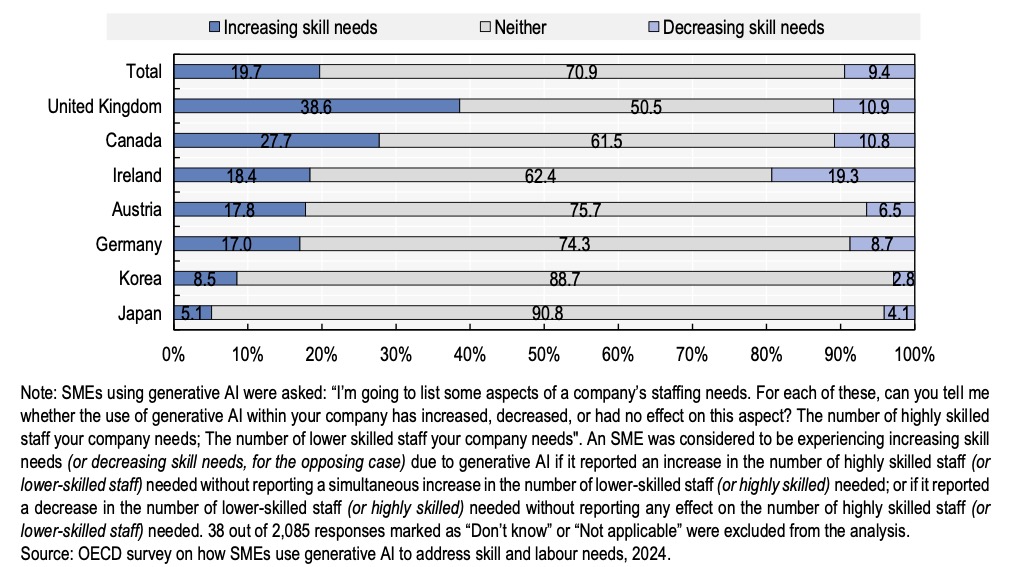
Twice as many SMEs said that generative AI increased their skill needs (20%) as said that it decreased them (9%). The skills growing most in importance are data analysis, interpretation, and creativity.
Interestingly, even SMEs that are not yet using AI remain optimistic: many believe that generative AI could help them overcome skill gaps or staff shortages. This suggests that there’s a latent appetite for experimentation and that access to the right support and training could tip non-users into users.
Reduced dependency on contractors for some, increased for others
In our study of adoption of predictive AI, published in 2021, Keegan, Yen and I flagged a risk of over-reliance on AI contractors, which could lead to deskilling and dependency on third-parties for strategic areas.
In this report, which is focused on generative, not predictive, AI, the authors state that:
“14.3% of SMEs report that generative AI reduced their reliance on external contractors. It could be that generative AI enables SMEs to perform tasks that they previously would have outsourced, given limited skills or resources in house. Indeed, SMEs that say that generative AI enables them to perform new tasks are 50% more likely to say that their reliance on external contractors decreased (18.2%) compared to those that say it does not enable to perform new tasks (12.4%). On the other hand, 6.3% of SMEs say that generative AI has increased their reliance on external contractors, which could be because some SMEs contract services to get the most out of this new technology (for instance, to build a custom platform for the company or seeking advice on how to comply with regulations). SMEs using generative AI for complex tasks are more than twice as likely to say that their reliance on external contractors had increased (11.7%), compared to those using it for simple tasks (4.5%), which supports this hypothesis.” (p.34)

Barriers to adoption
The most frequently cited barriers to adoption were:
- Unsuitability to the firm’s work, particularly in sectors that depend on physical or highly regulated activities (57%)
- Legal, copyright, and regulatory concerns (54%)
- Data privacy worries (52%)
- Lack of skills among employees (50%)
- Client disapproval, especially in the education sector and in Germany
Cost, which is often seen as the main obstacle to AI adoption by SMEs, was not flagged as a significant barrier. This could be because many generative AI tools are inexpensive or even free, and shows that the real challenge to adoption seems to be confidence to use the tools, not ability to afford them or difficulty in trialling them.
In summary, the OECD’s findings paint a picture of cautious optimism regarding adoption of generative AI among SMEs. There is scope for SMEs to move from efficiency-driven, peripheral use cases (e.g. writing, summarising) to innovation and revenue-driven ones focused on core activities such as product design or problem solving. But companies need confidence to try the tools, while leveraging staff’s analytical and creative skills.
Do these findings resonate with your experience?

 Ana Canhoto