
One of my colleagues has completely redesigned their module. Generative AI is now central to every workshop and even assessment, with the aim of preparing students are ready for a job market that increasingly demands generative AI skills. In contrast, another colleague started using in-class assessment, with pen and paper, to ensure assessment integrity.
These two opposed approaches are evidence of the same fact: whether you embrace generative AI or reject it, as an educator you simply can’t ignore it.

With this in mind, a group of 10 academics, have come together to provide strategic guidance for Marketing Educators, Programme Leaders, and Professional Bodies navigating the integration of generative AI in marketing curricula. This effort was led by Chahna Gonsalves, and resulted in the publication of a white paper:
Gonsalves, C., Clancy, M., Khusainova, R., Lee, H.-H., Marshall, K., Percy, S., Quamina, L., Vuković, S., Canhoto, A. I., & Baines, P. (2026). Marketing education in the age of generative AI: Preparing graduates for human–AI collaboration. Academy of Marketing Marketing Education SIG, Academy of Marketing. https://doi.org/10.18742/pub01-237
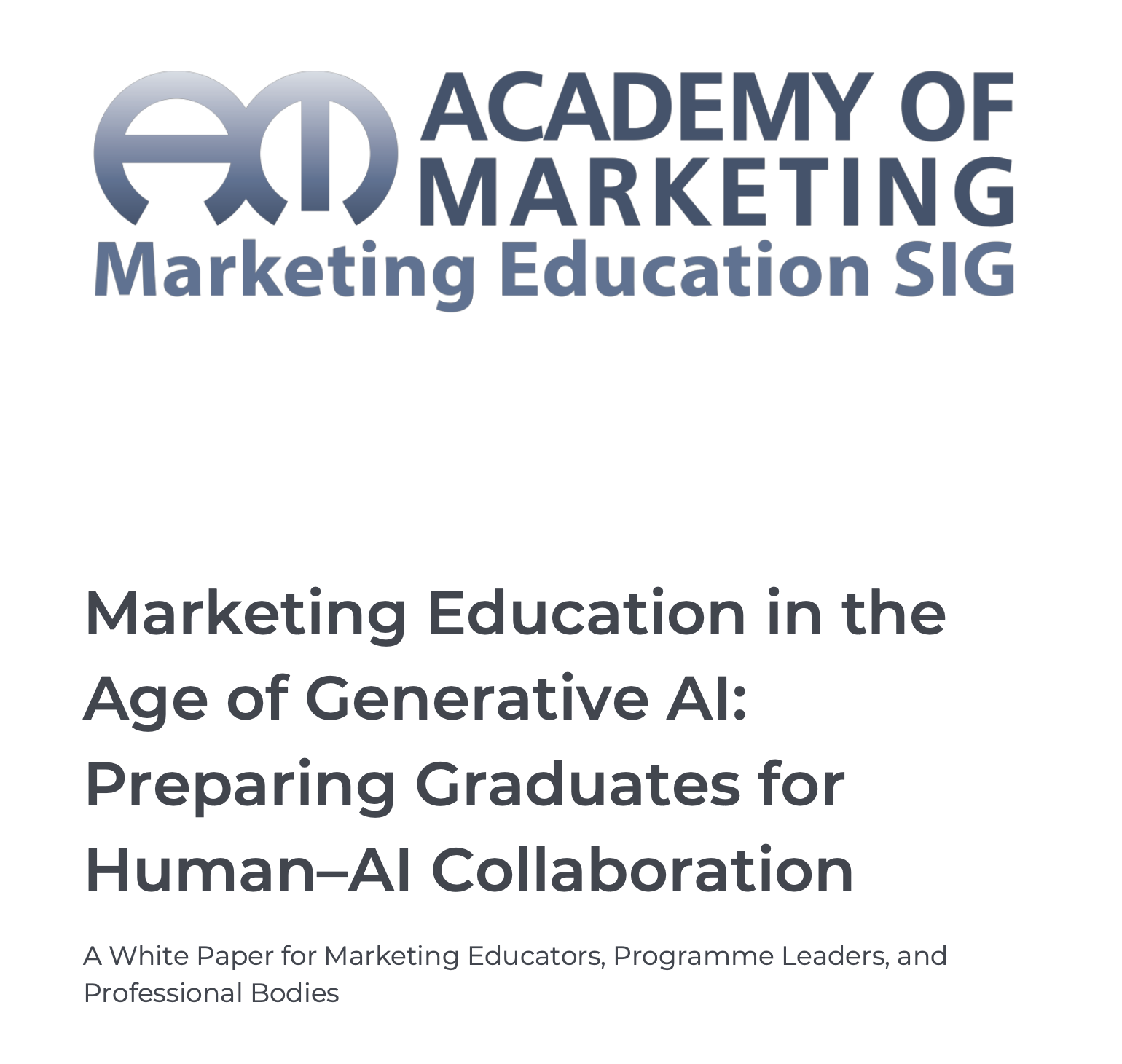
This white paper is neither a defence nor a take-down of generative AI use in university education. Rather, it is an in-depth consideration of the impact of this technology on the curriculum, pedagogy, assessment, employability, governance, and equity & inclusion, in the context of marketing education.
Drawing on survey evidence, literature and case studies, we discuss opportunities and challenges, and argue for intentional educational design grounded in transparency, accountability, and human-led reasoning.
Our paper concludes with a discussion of what we see as the six strategic priorities for marketing education in the UK, responding to both immediate pedagogic pressures as well as longer-term institutional and market expectations, as summarised in pages 4 and 5 of the report:
1. Align curriculum with human-in-the-loop practice.
AI literacy and ethical reasoning should be embedded across core modules. Prompting must be taught as a strategic communication skill rooted in brand voice, audience understanding, and cultural nuance. Studio-style and iterative tasks – where students critique, adapt, and justify AI outputs – help preserve the interpretive, reflective, and strategic foundations of marketing learning.
2. Redesign assessment around reasoning and accountability.
Assessment must focus on decision-making rather than polished artefacts. AI-use disclosures, prompt and version logs, verification notes, and oral defences make reasoning visible. AI-inclusive marking criteria should evaluate critical reflection, ethics, verification practice, and justification. These structures enhance integrity and align with professional expectations for accountable AI use.
3. Build staff capability in judgement-led pedagogy.
Educators do not need technical expertise but require confidence in facilitating critique, ethical deliberation, and inquiry. Professional development should target judgement, bias awareness, and responsible data practice—not tool demos. Peer exchange and team-teaching support consistent programme cultures.
4. Ensure equitable and inclusive access.
Without coordinated provision, AI risks widening attainment gaps. Institutions should supply approved tools or design activities around accessible models. AI literacy must begin at induction, supported by academic skills programmes. Universal Design for Learning principles should guide AI-enabled support for multilingual, disabled, and neurodiverse learners.
5. Align institutional policy with educational design.
Policies should provide clear operational expectations within module documents and assessment templates. Institutions must standardise AI guidance, integrate emerging regulatory frameworks, and ensure consistency across teaching, research, and partnerships.
6. Strengthen industry collaboration.
Employability now depends on demonstrating responsible human–AI collaboration. Institutions should work with industry partners to adopt privacy-safe, AI-enabled workflows for teaching and live projects, including the use of synthetic datasets and version-control practices. Practitioner involvement in critique and defence processes enhances professional authenticity.
The team producing this white paper were:
- Chahna Gonsalves, Senior Lecturer in Marketing (Education), King’s College London, and Chair, Academy of Marketing Marketing Education SIG.
- Michelle Clancy, Lecturer and Postdoctoral Research Fellow, South East Technological University (Ireland).
- Rushana Khusainova, Senior Lecturer in Marketing and Education Lead, University of Bristol Business School.
- Hsin-Hsuan Meg Lee, Associate Professor in Marketing, ESCP Business School.
- Kristen Marshall, Assistant Professor in Digital Marketing, Heriot-Watt University (Scotland).
- Sarah Percy, Assistant Professor in Marketing, University of Birmingham (Dubai).
- La Toya Quamina, Senior Lecturer in Marketing, University of Westminster.
- Sunčica Vuković, Lecturer, University of Montenegro, Faculty of Economics.
- Ana Isabel Canhoto, Professor of Digital Business, University of Sussex Business School.
- Paul Baines, Professor of Political Marketing and Head of Executive Education, University of Leicester.
The paper is was published in open-access format by the Academy of Marketing. You can find it here.
How are you redesigning your practice in response to generative AI? What trade-offs are you finding hardest to resolve?

 Ana Canhoto
One thought on “New white paper: Marketing Education in the Age of Generative AI”