
In episode 11 of season 11 of the Marketing Companion, Mark Schaefer and his guest, Jay Acunzo, discuss “the meaning of brand and personal relevance in a world exploding with new creative output”. Their discussion is focused on content creation, but the points that they cover are relevant well beyond this application. For instance, they talk about the importance of understanding the needs of your audience, and creating content that is relevant for that audience in a unique and clearly differentiated way.
At around 15m30s, Schaefer and Acunzo talk about the importance of being meaningful to a specific segment, as opposed to trying to be everything for everybody. The quote that they use is “It is a better to be a meaningful specific that a wandering generality”, which, I have since found, is an idea from Zig Ziglar.
This idea of focusing on one segment and serving it well is what, in marketing, is called targeting. I think that targeting is one of the most frequent pieces of advice I give to managers (closely followed by “focus on prospective costs, not sunk costs”; and “don’t assume that the customer is like you”).
But how does one choose which segment to focus on?
It requires a two-pronged approach: we need to identify how attractive different segments are; and we also need to assess the fit between that segment and the business’s capabilities. This approach is based on the GE-McKinsey matrix, which you can read about here (there is also a really good interactive presentation). But here is a quick overview of how it might be applied to help a café owner.
Step 1: Assessing segment attractiveness.
When it comes to evaluating a segment attractiveness, it is tempting to focus on direct segment attributes such as market size or profitability. Though, it is also worth considering how competitive the industry is (number of competitors; how deep their pockets are; the extent to which our and our competitors’ products are substitutes, in our customers’ eyes, …). Plus, we could also wider industry aspects such as how easy (or difficult) it is to enter or leave this industry (as that will dictate the number and type of competitors we face), whether the product is high or low learning (as that will dictate how easy it is for customers to adopt it), and so on.
Once you identify the key factors, you assign a weight to each factor, and, then, rate each segment in terms of those factors.
For instance, imagine that, as the owner of a small café, you decide that:
- Profit margins is your key deciding factor, and it should account for 50% of your decision; then,
- Segment size for 30%; and, finally,
- Market growth for the remaining 20%
You may also identify three key segments: Students (A), Commuters (B), and C (tourists). The assessment of the segments’ attractiveness would look something like this:

This step is telling us that, even though the segment of students is very large, they are actually not the most appealing because they are price sensitive and the segment is not growing much in numbers.
Step 2: Assessing business fit
While a segment may be very attractive in absolute terms, it may be that they are simply not the right one for us, at this point in time, because we do not have the right skills or positioning to meet their needs. For instance, maybe they require a range of product solutions that we can’t provide at this point in time, or they may expect a level of service that we do not offer. Thus, we also need to identify the key factors valued by our different segments and how much they weight in their decision. Then, we need to assess how well our business does in terms of meeting the needs of each segment, in their eyes.
For our small café, through market research, we may conclude that key factors include:
- Range of products on offer
- Catering to specific dietary requirements
- Quick service
- Table service
We may also find that each factor is valued by the different segments as shown in the blue column, and that in the eyes of our customers we perform as shown in the yellow column. Multiplying one by the other gives us the scores in the green column:

Step 3: Putting it all together
If we put these two types of factors together we would conclude that segment B (commuters) would be our ideal segment to target:
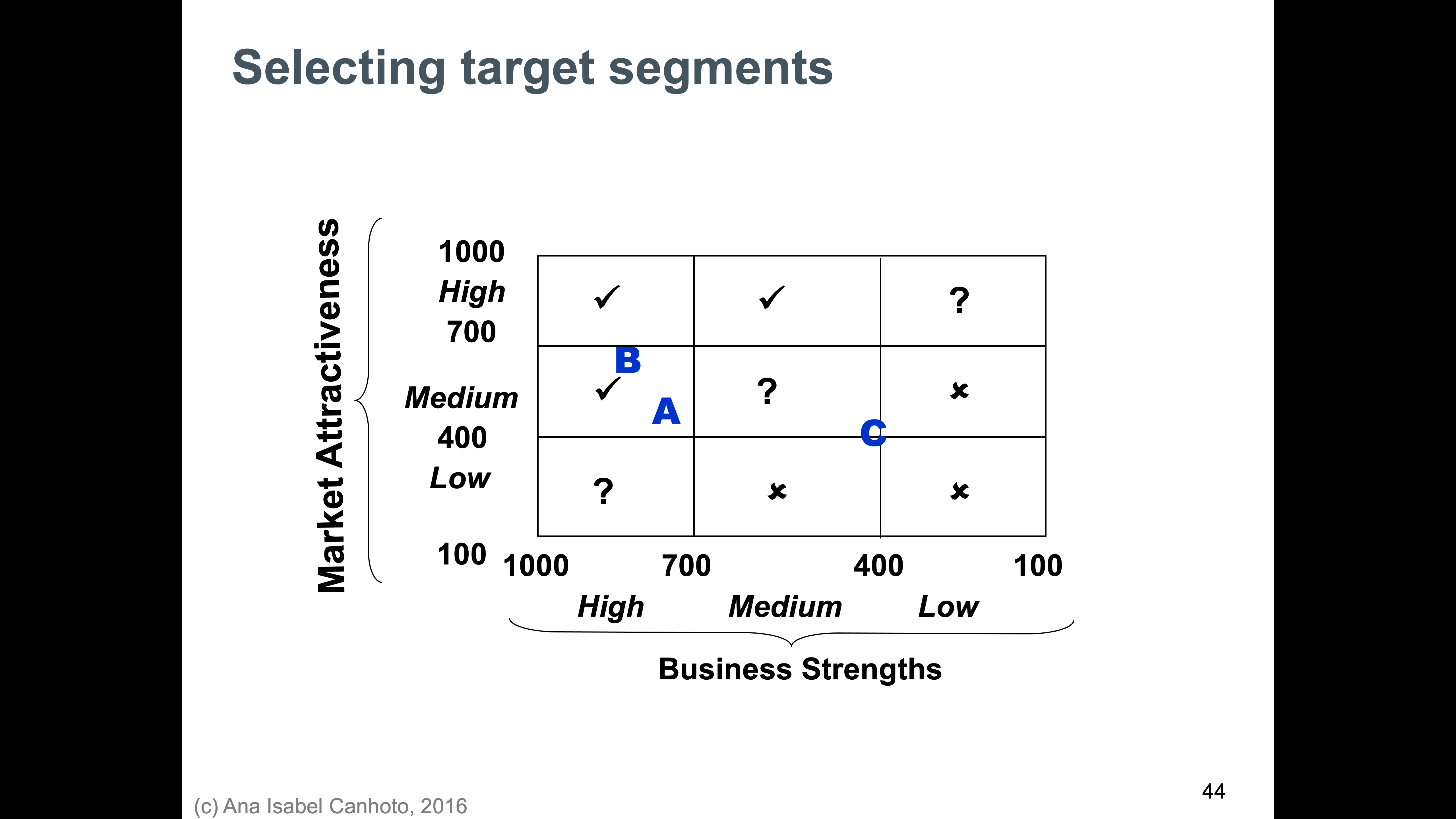
Where do we go from here? Does this mean that we will not serve the other segments?
No, not at all.
We will serve the other segments, too, but our operations need to be designed in order to serve segment B’s needs really well. If we try to cater to all of our segments’ needs, for instance, by having lots of options on the menu (for segment A) and also using valuable store space for tables and chairs (for segment C), service will slow down because people take longer going through the menu, it takes us longer to prepare food items because we need to keep switching between different preparation routines, and we clutter my store space with tables and chairs that hardly get used.
Moreover, our communications need to be streamlined to clearly signal to segment B that we offer exactly what they look for. Our logo could suggest speed, our tag line could use action words like “grab” or “on the move”, and so on.
The bottom line is, don’t be afraid to narrow the focus of who you are serving, as a business – whether you have a coffee shop or are a creative, as in the case of the podcast mentioned at the top of this post. It may look like you are leaving money on the table, but what you are actually doing is entering a zone whereby you are using your limited resources to delight and grow your key segment:
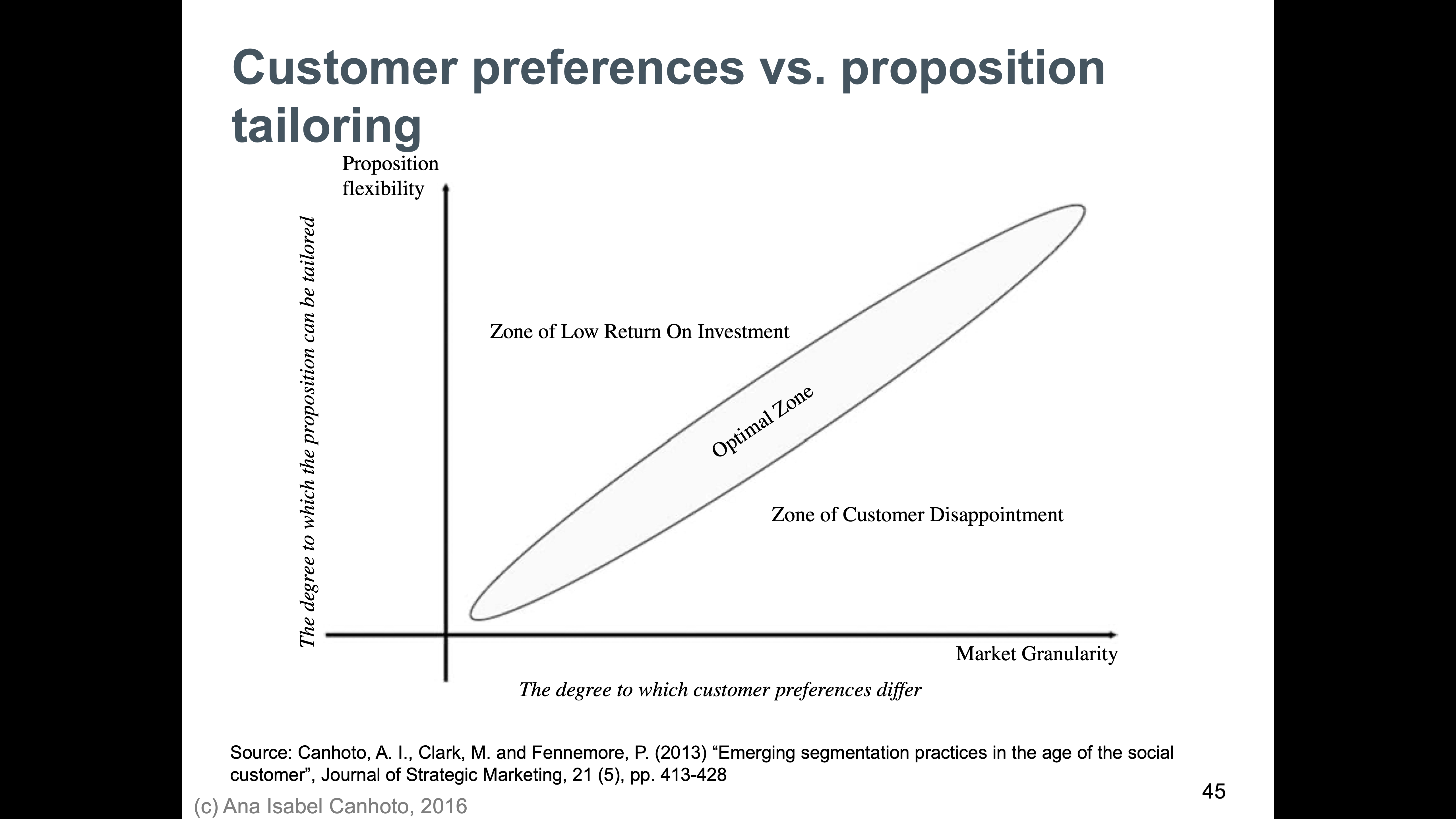
Image source
Delighting customers will ensure their loyalty, and also trigger word mouth or observational learning. Here is a great example: The Happiest Country in the World Just Found a Brilliant Way to Attract Tourists.

 Ana Canhoto