
Here is my regular update on the key, written research outputs from the last 12 months. I continued to write mostly about use of technology – both user behaviour and business opportunities.

One of the papers (Snakes and Ladders) is co-authored with a former student, something that I find particularly rewarding. The other two are the first output in two new and very exciting research collaborations.
The purpose of this yearly catch-up post is to make it easy for you to see what I have been working on. But I also want to encourage you to reach out, if you want to discuss how my research can help your organisation or how we can work together.
Journal articles
- Canhoto, A.I., Keegan, B. J. & Ryzhikh, M. (2023) Snakes and Ladders: Unpacking the Personalisation-Privacy Paradox in the Context of AI-Enabled Personalisation in the Physical Retail Environment. Information Systems Frontiers, DOI: 10.1007/s10796-023-10369-7
Abstract:
Artificial intelligence (AI) is expected to bring to the physical retail environment the kind of mass personalisation that is already common in online commerce, delivering offers that are targeted to each customer, and that adapt to changes in the customer’s context. However, factors related to the in-store environment, the small screen where the offer is delivered, and privacy concerns, create uncertainty regarding how customers might react to highly personalised offers that are delivered to their smartphones while they are in a store. To investigate how customers exposed to this type of AI-enabled, personalised offer, perceive it and respond to it, we use the personalisation-privacy paradox lens. Case study data focused on UK based, female, fashion retail shoppers exposed to such offers reveal that they seek discounts on desired items and improvement of the in-store experience; they resent interruptions and generic offers; express a strong desire for autonomy; and attempt to control access to private information and to improve the recommendations that they receive. Our analysis also exposes contradictions in customers’ expectations of personalisation that requires location tracking. We conclude by drawing an analogy to the popular Snakes and Ladders game, to illustrate the delicate balance between drivers and barriers to acceptance of AI-enabled, highly personalised offers delivered to customers’ smartphones while they are in-store.
Keywords: Artificial intelligence · Personalisation · Privacy · Personalisation-privacy paradox · Retail · Geo-location
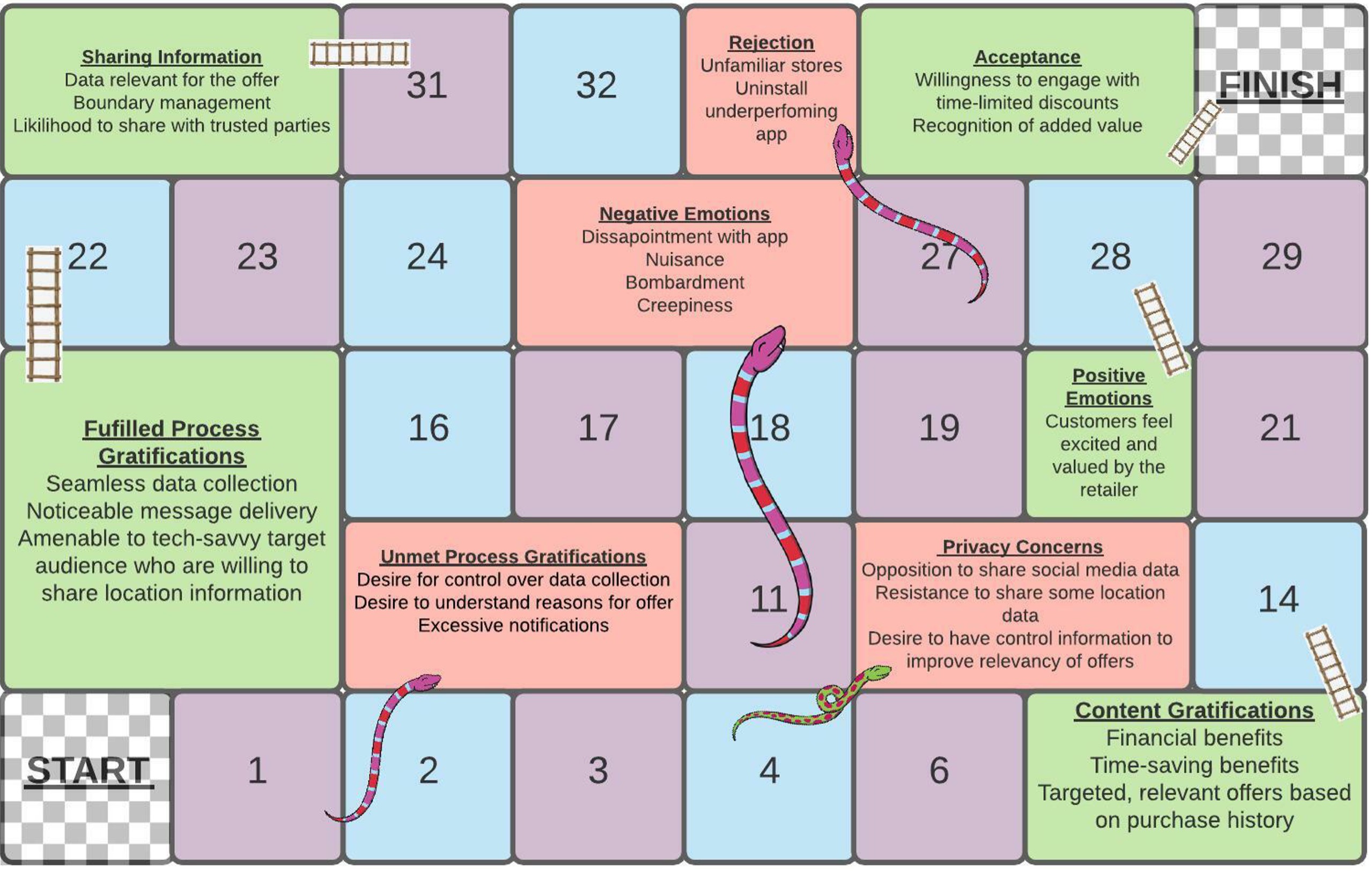
You can find the paper, here; and a related blog post, here.
- Keegan B.J., McCarthy I.P., Kietzmann J. & Canhoto A.I. (2023) On your marks, headset, go! Understanding the building blocks of metaverse realms. Business Horizons, https:// doi.org/10.1016/j.bushor.2023.09.002
Abstract:
In 2011, Business Horizons published the ‘social media honeycomb’ paper to help managers and scholars understand what was, then, a new form of media, its various platforms, and how to engage with it and learn to use it. Today, we face similar challenges and opportunities with the metaverse as we try to discover how to attract, enable, serve and capture value from users in some form of virtual world. In this article, we introduce the concept of a ‘metaverse realm’ (i.e., a specific type of metaverse space and community) and present the metaverse honeycomb model to explain the functionalities and affordances for different metaverse realms. We present two applications of the honeycomb model to show how different attention to immersive functionalities can characterize different metaverse realms. To conclude, we outline how the model could be used to strategically evaluate metaverse realms in terms of their external fit (i.e., the who-what-how of realms), internal fit (i.e., the trade-offs and synergies of realm functionalities), and life-cycles (i.e., roadmapping and directing realm evolution).
Keywords: Metaverse; Honeycomb model; Virtual reality; Non-fungible tokens; Blockchain; Digital economy

You can find the paper, here; and a related blog post, here.
- Berhanu, D., Rato, M. L., Canhoto, A. I., da Cunha, J. V., & Geraldes, R. (2023). Online information search by people with Multiple Sclerosis: a systematic review. Multiple Sclerosis and Related Disorders, 79. https://hdl.handle.net/10779/uos.24242869.v1
Abstract:
Background
People with Multiple Sclerosis (pwMS) search for information online about various aspects of living with their disease, but details about patterns of searching and outcomes are unclear. This means that opportunities to leverage online resources to support pwMS, and to enhance shared decision making, may be missed. We aimed to do a systematic review of the literature on digital information searching by pwMS.
Methods
We performed a systematic search for studies assessing online information seeking of pwMS in MEDLINE and JSTOR databases. Studies were screened and selected by two investigators. All study designs were included, risk of bias was assessed using the Critical Appraisal Skills Programme qualitative checklist. Reports were assessed for the proportion of patients searching information online about MS, type of information sought, online tools used by patients, perceived quality of the information acquired, and impact of online searching in pwMS.
Results
We identified 5 studies, including 10,090 patients. Most pwMS search for information online (53.8–82 %), which they rarely discuss with physicians. The most common topics are treatment, general disease information, symptoms, lifestyle recommendations, prognosis, and coping strategies. Patients that are younger, have a shorter disease duration, primary progressive MS, and during periods of disease worsening, are more likely to use online resources. Online information is perceived as low quality by pwMS.
Conclusions
Online information search is prevalent among pwMS. Despite concerns with the quality of the available information, only a minority of pwMS will discuss the information found with their physician. These findings highlight the importance of developing and providing quality online information resources for pwMS.
Keywords: Multiple Sclerosis; Internet; Information search; Online; Digital
You can find the paper, here; and a related blog post, here.
As usual, feel free to reach out if you want to learn more about these articles, if you want to discuss how my research can help your organisation, or of you simply want to explore opportunities to work together.

 Ana Canhoto