Venture capital firm Andreessen Horowitz (AZ) shared insights from interviews and surveys that they conducted with Fortune 500 companies about adoption of Generative AI. While we need to treat the AZ findings with care, because the company did not disclose details of the methodology and has vested interests in the information shared, the article still provides a number of interesting insights into why and how large companies are investing in Generative AI.
Of particular interest to me was how AZ’s findings about Generative AI reflect vs diverge from findings from my own work on AI adoption, and, in particular, those reported in the paper “Power Negotiation on the Tango Dancefloor: The Adoption of AI in B2B Marketing”, which was co-authored with Brendan Keegan and Dorothy Yen.
The “AI Tango” paper in a snapshot
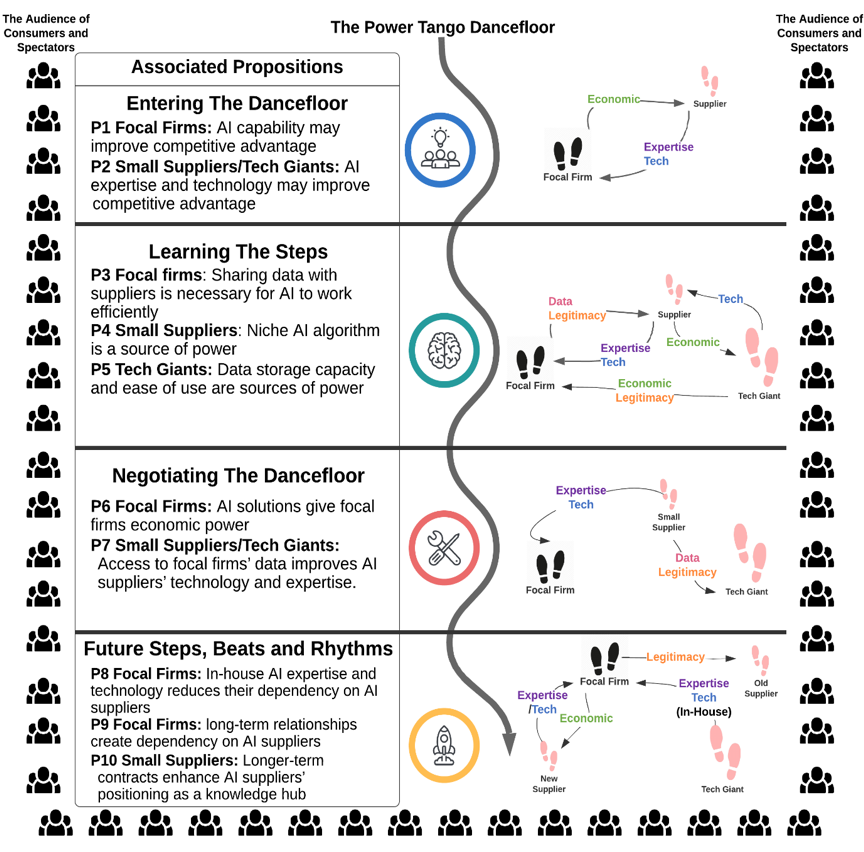
In that paper, which was about adoption of AI in general (not Generative AI), we described four stages of AI adoption, and analysed how power relations between the focal firm (i.e., the business deploying AI solutions), Tech Giants and niche AI suppliers shaped the AI strategy at each of those stages.
The four stages of AI adoption are:
- Entering the dancefloor: The decision to adopt AI
- Learning the steps: The first experiences with AI
- Negotiating the dancefloor: Ongoing use of AI
- Future Steps, Beats and rhythms: Future directions
And the strategic propositions that we developed for each stage are:
Generative AI adoption through the lens of the “AI Tango” paper
- The decision to adopt Generative AI
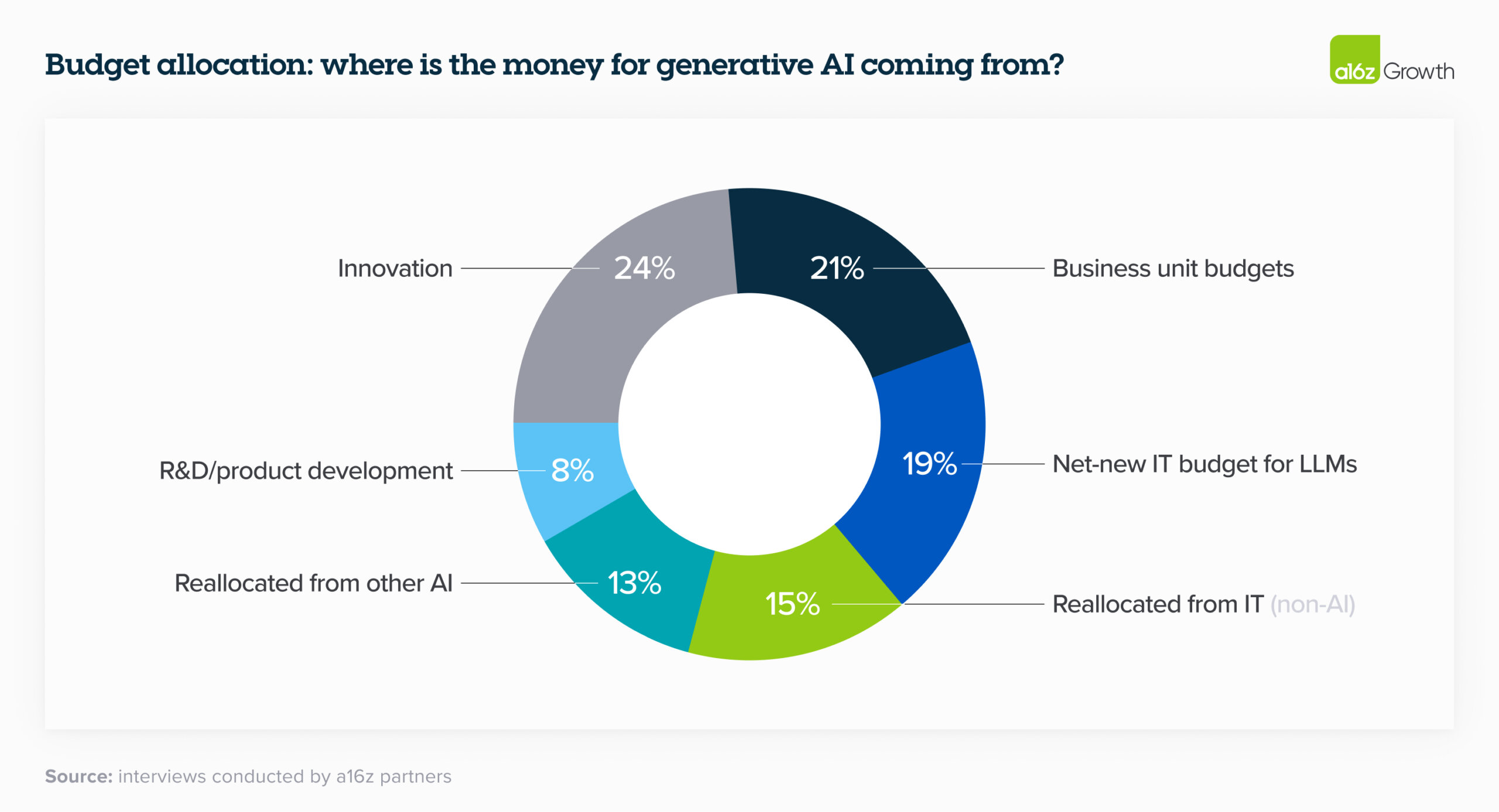
While some companies may be (or have been) driven by the potential of Generative for novel insights, by and large the main driver cited by AZ is the desire to save costs. This is discussed in point 2 of the report, supported by both anecdotal evidence and the fact that AI investments are increasingly coming from “regular” IT budgets, as opposed to Innovation or R&D ones.
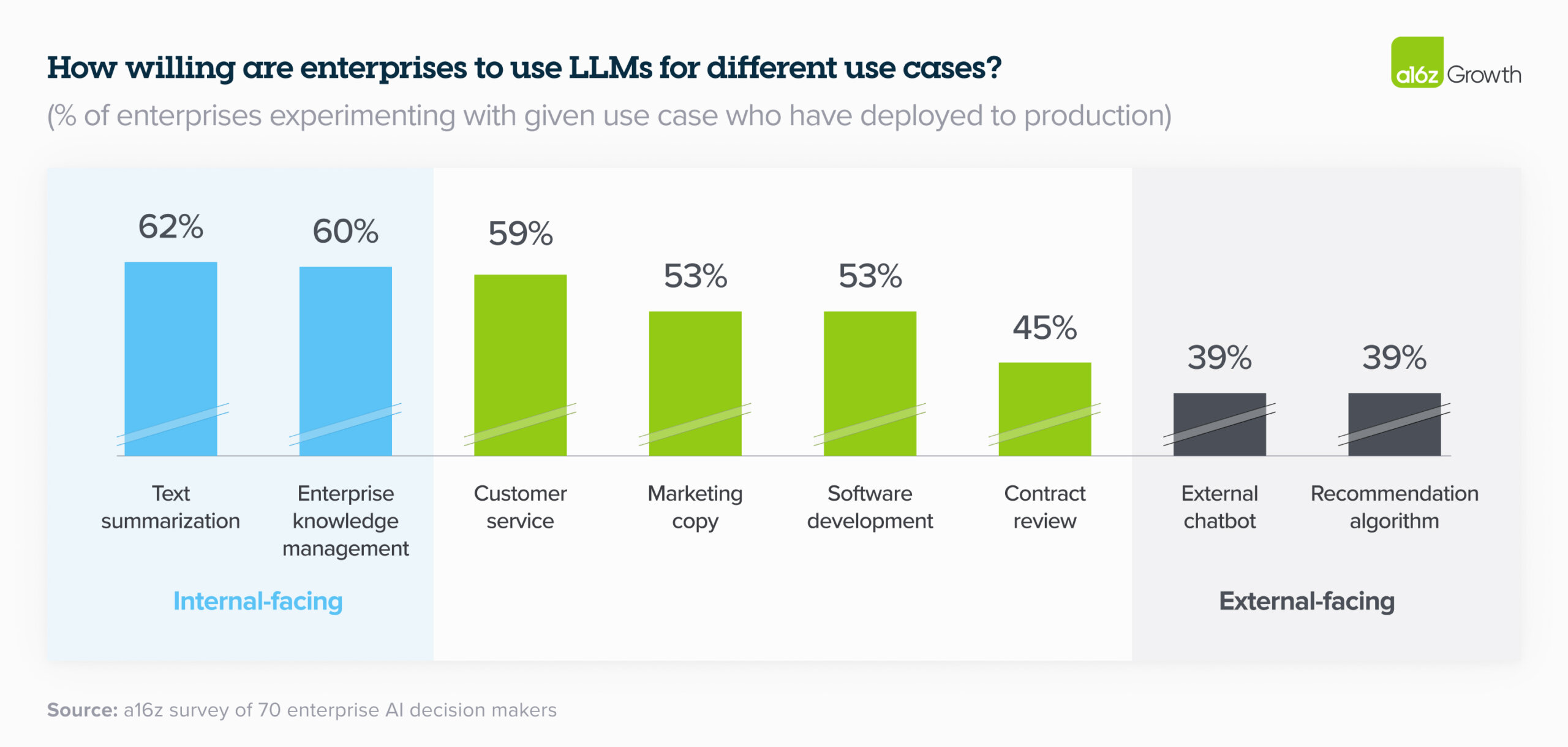
In our paper, we mention a third driver of adoption: the firm’s desire to be perceived as a competitive and credible business partner. This is not mentioned directly in AZ’s report (possibly because it was not asked in the survey). However, I would venture that, for the time being, it may actually be a deterrent. Indeed, in point 15 of the report, AZ mention that most use cases for Generative AI, so far, are internally focused or with a human in the loop. This focus is because of concerns with mistakes and public embarrassment.
2. The first experiences with AI
Mirroring what we mentioned in our paper, in AZ’s report companies are finding it hard to recruit the right talent and deploy and scale the required infrastructure:
“Simply having an API to a model provider isn’t enough to build and deploy generative AI solutions at scale. It takes highly specialized talent to implement, maintain, and scale the requisite computing infrastructure” (point 4, in the report).
Thus, companies largely enter this space by outsourcing to generative AI solution providers, and adapting existing technology to their needs:
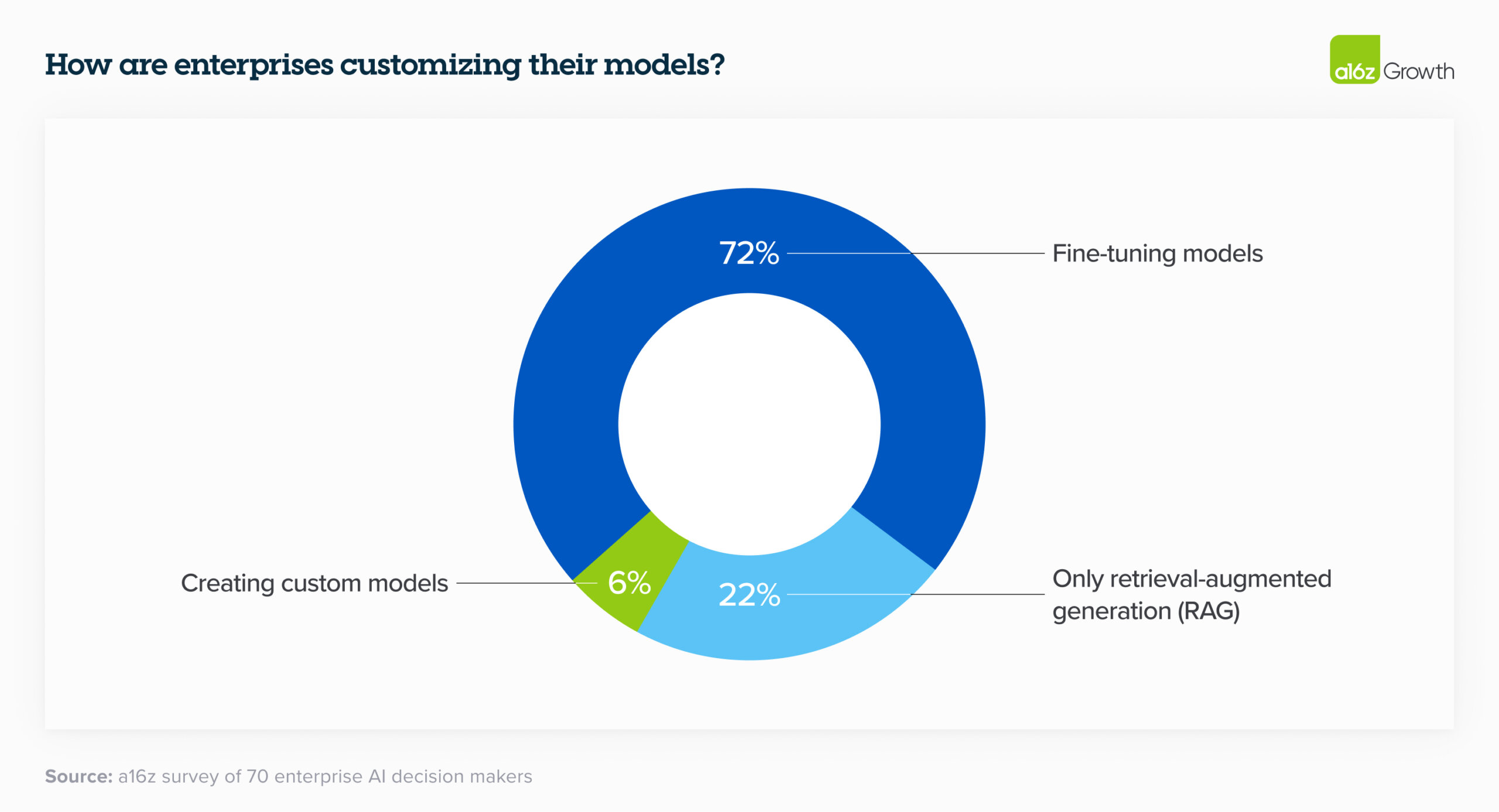
Another similarity with our own findings is that there is a tension between, on the one hand, large AI suppliers that can offer performance and, on the other hand, niche ones that offer customised solutions and advice.
3. Ongoing use of AI
In our research, over time companies converged into a small number of AI technologies and suppliers. However, in AZ’s research, companies are experimenting with increasing numbers of different Generative AI models. According to point 5 of the report:
“Just over 6 months ago, the vast majority of enterprises were experimenting with 1 model (usually OpenAI’s) or 2 at most. When we talked to enterprise leaders today, they’re are all testing—and in some cases, even using in production—multiple models”.
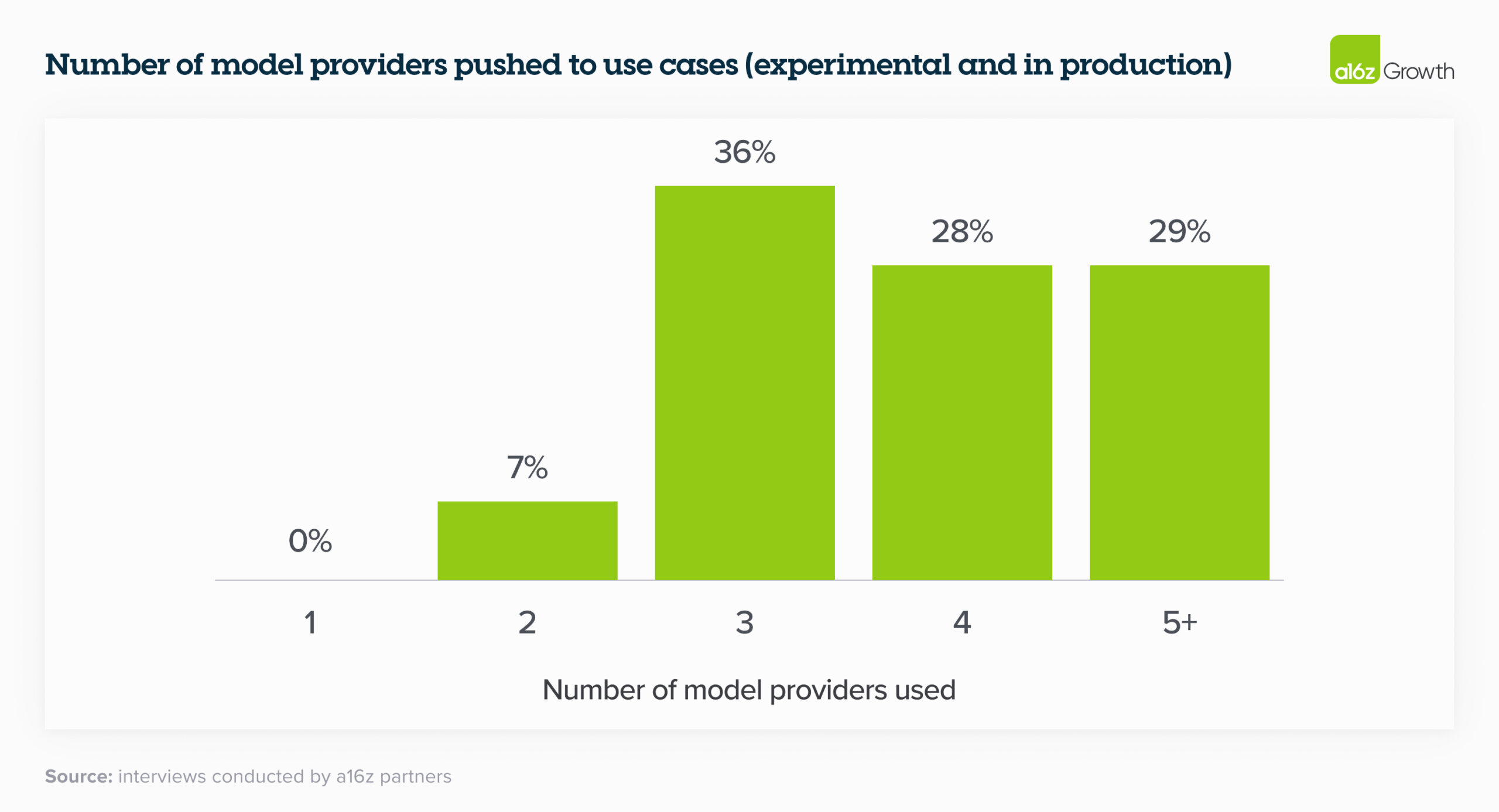
In particular, companies are very keen to experiment with open source models:
AI leaders noted that they were interested in increasing open source usage or switching when fine-tuned open source models roughly matched performance of closed-source models.
This diversification of suppliers and underpinning technologies reflect one phenomenon highlighted in our research: The transfer of data from focal firms to AI suppliers and the reliance on the supplier for talent and processing capability leads to a growing dependency of the focal firm on its AI suppliers. In our research, we found evidence of AI suppliers taking advantage of clients’ dependency on their solutions, when renegotiating contracts. Firms try to avoid being locked-in to specific suppliers or models, particularly given the rapidly changing landscape and associated uncertainty. Hence, “control” being the key concern cited by firms, to embrace open-source:

4. Future directions
In our paper, we noted a division between companies that invested in acquiring the skills and resources to develop their AI solutions in house, vs. those that became more and more dependent on AI suppliers. Moreover, we said that that division more or less aligned with the company’s awareness of the value of their proprietary data, and its ability to hold on to their datasets.
For the case of text based Generative AI, the AZ report finds that large companies are falling mostly in the first group – i.e., develop solutions in-house. According to AZ, that is because of the relatively low barriers to experimenting with LLMs:
The foundation models have also made it easier than ever for enterprises to build their own AI apps by offering APIs.
Thus, AZ predict that the winners, on the AI supply side, are those companies that “significantly rethink the underlying workflows of enterprises or help enterprises better use their own proprietary data”, rather than simply building “GPT wrappers”.
In summary, savings continue to be a key driver of (generative) AI adoption and data the key source of power. However, we can also identify some nuances in how focal firms and AI suppliers are navigating the generative AI landscape, with less emphasis on external facing applications, more willingness to experiment, and greater effort to avoid premature commitment to a specific supplier or technology.
In your view or experience, what else is peculiar about adoption of Generative AI?

 Ana Canhoto
One thought on “The AI Dancefloor revisited: adoption of Generative AI”