
The question of when customers will welcome vs reject an AI recommendation is important from both a practical and a conceptual perspective. From the practical perspective, the answer to this question will inform investment in AI recommendation systems (where to invest, risks faced, AI-system features…). From a conceptual one, the answer reveals the boundary conditions of the theories that are being developed related to human-AI interaction.
My own previous work looking at AI in-store (i.e., NOT online) recommendations for fashion items has shown, for instance, that customers are more willing to accept recommendations from brands that they are familiar with than new ones. Moreover, customers value discounts over outfit suggestions, possibly because they do not trust the AI’s ability to make aesthetic choices.
Though, as this is a relatively new field, there’s still much to be understood. For instance, how does the wording of the recommendation influence customers’ willingness to accept it?
Based on research by Fei Jin and Xiaodan Zhang, it seems that customers are more willing to accept an AI-recommendation when it focuses on the material / tangible aspects of the product rather than the experiential ones. For the latter, customers are more willing to accept the recommendation when it is framed as originating from a human agent.
Here is an example of one of the experiments designed by Jin and Zhang. The authors presented users of an online platform with the recommendation for the trainers below.
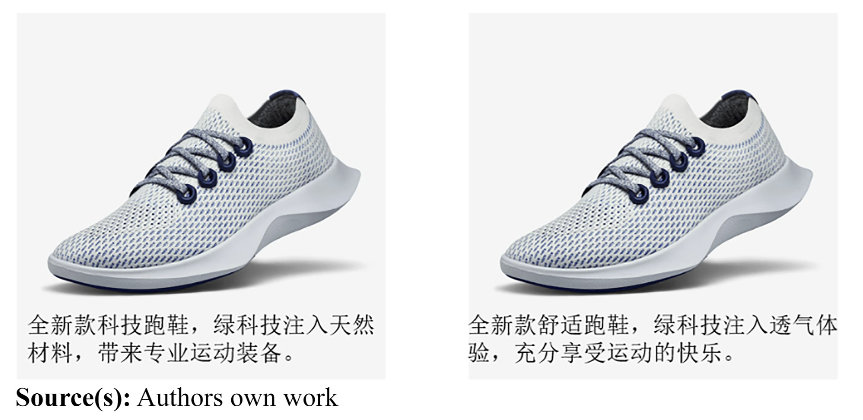
Some participants saw a recommendation emphasising the tangible aspects of the product, saying: “New high-tech running shoes, with green technology using natural materials. Bring you professional sports equipment.“
The remaining participants saw a recommendation emphasising the experiential aspects: “New comfortable running shoes, with green technology giving a breathable experience. Allow you to fully enjoy sports.”
Moreover, half of the participants in each condition where told that the recommendation had been produced by an AI agent, while the others were told that the recommendation had been produced by a human.
The impact of message type and source on intention to purchase was as thus:
| Recommendation scenario | |||
| AI-agent | Human-agent | ||
| Message emphasis | Tangible aspects | 5.24 | 4.08 |
| Experiential aspects | 4.23 | 5.16 | |
Moreover, the authors found that the participants also perceived the competence of the recommending agent differently, depending on the message emphasis (see table below), and that this effect moderated the relationship between recommendation type and purchase intention.
| Perceived competence | |||
| AI-agent | Human-agent | ||
| Message emphasis | Tangible aspects | 5.18 | 4.54 |
| Experiential aspects | 4.27 | 5.06 | |
The authors conducted three other experiments related to the interaction between recommendation and recommender type, as reported in the paper “Artificial intelligence or human: when and why consumers prefer AI recommendations”.
What I find interesting about this study is that it goes one level deeper than work done before by myself and others, which focused on product type (e.g., fashion). Instead, what Jin and Zhang’s series of studies indicates is the importance of aligning the type of message with the perceived competence of the type of agent. Because consumers do not (yet?) see AI as having emotional competence, it is counter-productive to use it in scenarios that emphasise experiential abilities, be it the sensorial experience of comfort as in the case of Jin and Zhang’s study, or the aesthetic experience of fashion choices as in ours.
What other aspects of human-AI interaction should we explore to ensure that recommendations meet customer expectations and enhance satisfaction? Your insights might spark the next research project!

 Ana Canhoto
2 thoughts on “When Do Customers Trust AI-recommendations?”