Here is my regular(ish) update on the key research outputs published in the last year or so. As always, I welcome readers who want to reach out to discuss any aspects of this work, or opportunities to collaborate.

Journal articles
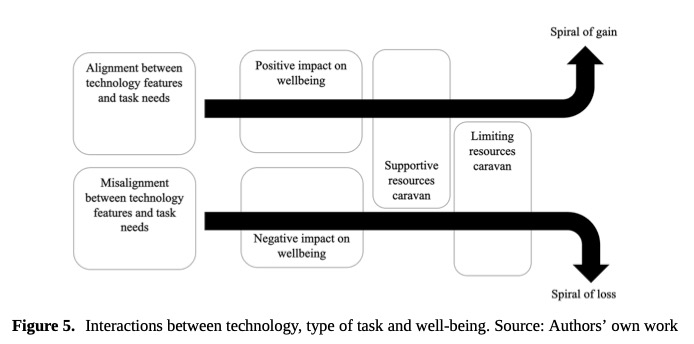
- Canhoto, A.I., Manika, D., Wainwright, E. & Holder, D.-M. (2025), The impact of technology: how features, resources and task demands shape digital well-being. Information Technology & People, Vol. ahead-of-print No. ahead-of-print. https://doi.org/10.1108/ITP-01-2024-0077
Abstract:
Purpose – Despite growing awareness that digital technology has both positive and negative implications, the role of specific features in shaping users’ overall well-being remains inadequately understood. We aim to investigate the relationship between technology features, type of task, users’ resources and well-being, to address conflicting empirical evidence in the extant literature.
Design/methodology/approach – We draw on the Conservation of Resources theory and Involvement theory to analyse user experiences with the digital platforms of a local authority in England. We use an explanatory case-study, nested in a critical realist perspective, and draw on observations, document analysis and interviews with two stakeholder groups.
Findings – We find that digital well-being is a situated condition shaped by users’ goals, resources and experiences. This explains why the same technology feature – e.g. self-service – supports well-being in low-involvement tasks but not in high-involvement ones. We also show that the hedonic and functional aspects of technology are interdependent in the production of digital well-being and describe how the alignment between resources’ affordances and the users’ specific needs and goals shape well-being.
Originality/value – We address the conflicting evidence regarding the impact of digital technology on well-being, in the extant literature. This will support future researchers to critically analyse under what conditions technology will benefit vs harm individual well-being and society. It also highlights the importance of designing digital platforms that are aligned with the level of user involvement, to create digital solutions that promote user well-being and foster an inclusive society.
Keywords: Digital technology, Digital well-being, Social value, e-government, Marginalised communities, Conservation of resources theory, Involvement theory
You can find the paper here and the associated blog post here. You can also access a podcast episode about this project, here.
- Castillo, D., Canhoto, A.I., & Said, E. (2024). When AI–chatbots disappoint – the role of freedom of choice and user expectations in attribution of responsibility for failure. Information Technology & People. Vol. ahead-of-print No. ahead-of-print. https://doi.org/10.1108/ITP-03-2024-0324
Abstract:
Purpose – The implementation of AI-powered chatbots in the frontline may enhance efficiency, yet failures are still common. This paper explores users’ attribution of responsibility for service failures when using AI-chatbots and examines how contextual factors influence perceptions of blame.
Design/methodology/approach – This work utilizes a mixed methods approach, leveraging the findings from 39 exploratory interviews to develop the research framework and hypotheses. Subsequently, two experimental studies evaluated the type of interaction, failure type and failure severity.
Findings – The qualitative study identified voluntary and forced interaction types perceived by users based on contextual factors and demonstrated how these types impact expectations and responsibility attribution post-failure. The experimental studies showed that forced interactions intensify responsibility attributions towards the company, and that disconfirmation of expectations mediates the relationship between forced interactions and responsibility attribution. Furthermore, failure type and severity level have a moderating influence on responsibility attribution.
Originality/value – This paper contributes to the theoretical understanding of user interactions with AI-powered frontline technology, by revealing the nuanced ways in which users perceive and react to failures.
Keywords: Chatbots, Artificial intelligence, Affordances, Frontline technology, Service failure, Attributions

You can find an open version of the paper, here. And the associated blog post, here.
Book chapter
- Tabaghdehi, S.A.H., Canhoto, A.I. and Braganza, A. (2024), The Duality of Smart Technology, Tabaghdehi, S.A.H. and Foroudi, P.(Ed.) Business Strategies and Ethical Challenges in the Digital Ecosystem, Emerald Publishing Limited, Leeds, pp. 7-18. https://doi.org/10.1108/978-1-80455-069-420241002 ISBN print: 978-1-80455-070-0
Description
The advent of the smart technology era has brought forth unprecedented opportunities and challenging risks, extending beyond individual, organisational and societal boundaries. These vulnerabilities are deeply interconnected with contextual factors such as technology accessibility, user competence and the wide-ranging consequences of technology utilisation that necessitates context-aware solutions. In this policy recommendation that was presented to the UK policymakers, we specified that to pave the way for socially responsible smart technologies, companies must explore and address risks stemming from the connectivity and cognitive capabilities of smart systems throughout their lifecycle stages, encompassing data input, processing and output. We emphasised that effective risk management demands a multifaceted orchestration of proactive (push) and reactive (pull) measures to mitigate harm. Furthermore, we indicate that smart technology’s transformative potential has the capacity to revolutionise competition across industries, redefining innovation. However, this transformation introduces substantial risks that extend beyond corporate boundaries, affecting individual well-being and safety. Consequently, responsible innovation and mitigation strategies are imperative. Finally, we highlighted that global consumer decisions about smart technology adoption tend to be influenced less by geopolitical factors and more by complex motivations that weigh technological promises against perceived risks. The pursuit of socially responsible smart technology represents a multilayered effort tackling challenges that transcend conventional boundaries while empowering technology developers to embrace innovation.
You can find further information here. And information about the work underpinning it, here.
Other publications
- Beltagui, A., Canhoto, A. I., McCloskey, J., Alizamani, A., Castilo, D., Behbehani, R., Kumar, N. & Schnieder, M. (2024). Beyond Ownership: Business models for sustainable, smart appliances. End of project report
End of project report is available at https://interact-hub.org/2024/11/20/beyond-ownership/ And more information here.
As usual, feel free to reach out if you want to learn more about these or other projects that I am working on.

 Ana Canhoto