
The same qualities that make Generative AI agents valuable can become liabilities when this technology is deployed without appropriate controls. Their adaptability may produce inconsistent guidance across similar situations, while its fluency obscures the poor quality of the reply due to missing or wrong information.
For many organisations, the operational advantages of deploying AI are too significant to ignore. So, the challenge becomes: how can organisations design generative AI interfaces that deliver both the responsiveness that users expect and the reliability that critical operations require?
From promise to practice
A team of academics and managers explored this exact question, in relation to the management of critical infrastructure (an environment where errors are costly, stakes are high, and reliability is non-negotiable).
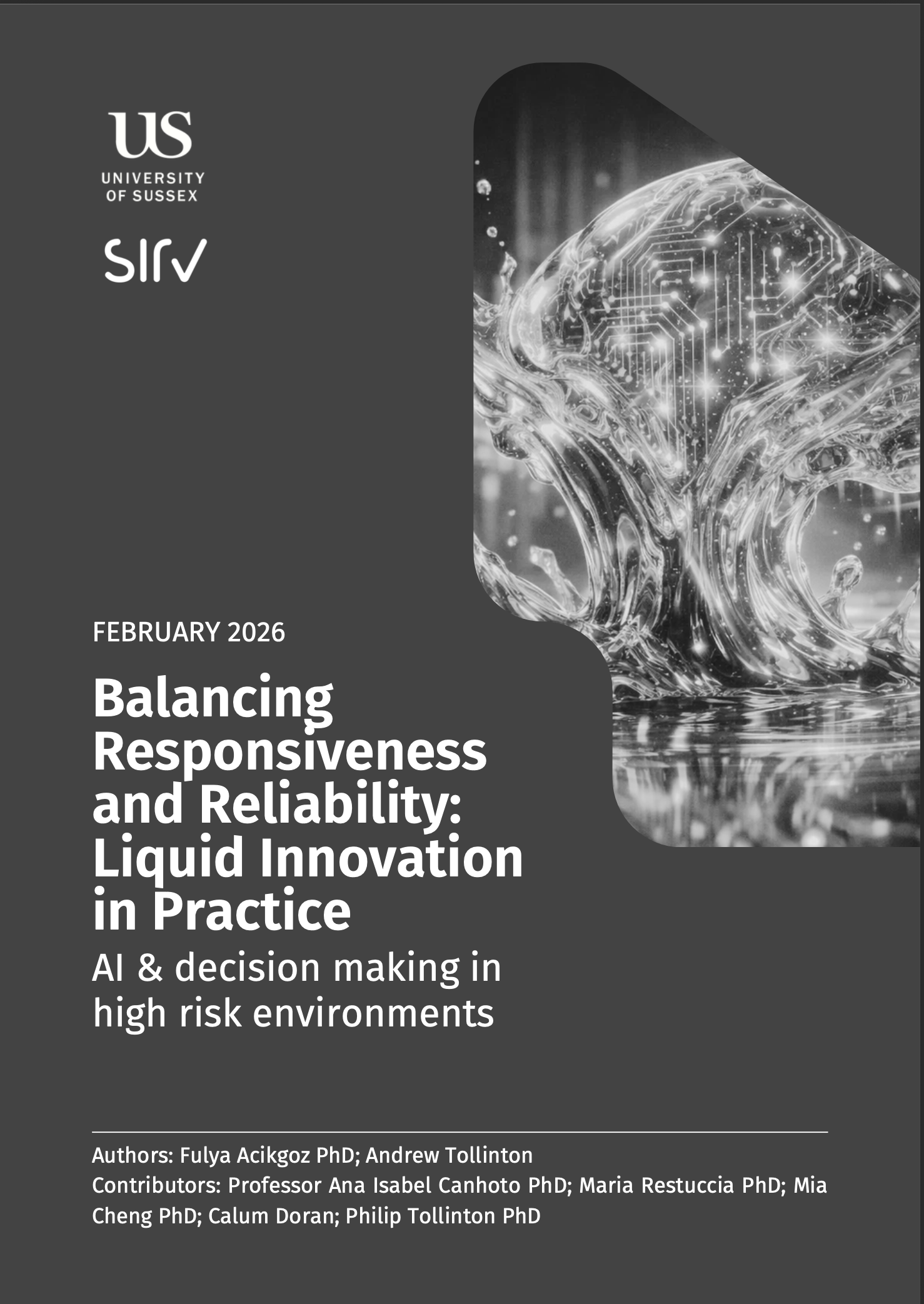
The result of this exercise is a new white paper, co-authored by my colleague Fulya Acikgoz and Andrew Tollinton. The paper builds on the concept of liquid innovation (see Spanjol et al., 2024), which captures how digital technologies enable flexible, fluid forms of value creation; and SIRV’s experience managing operational risk in critical infrastructure environments.
Five principles for responsible deployment
The white paper outlines five practical principles for organisations seeking to harness generative AI without compromising reliability.
- Start where stakes are highest – Identify the areas where errors would have the greatest operational or societal impact, and design safeguards accordingly.
- Augment rather than replace existing systems – Use AI to support established processes, not to bypass them prematurely.
- Anchor outputs in evidence – Ensure that AI-generated responses are grounded in verified data sources and traceable information.
- Embed governance by design – Build oversight, accountability and escalation mechanisms into the architecture of the system.
- Expand only after value is proven – Scale incrementally, based on demonstrated reliability and measurable benefit.
In a recent post, I discussed a study led by Andrew M. Bean, published in Nature Medicine, which showed that language models performing impressively in isolation can underperform when interacting with real users. The key lesson was simple but important: AI performance is not a property of the model alone. It is a property of the human – AI system. This white paper contributes to the discussion around AI performance by arguing that if AI performance is relational, then so is AI responsibility, and offering a structured way to balance adaptability with control. You can access the full white paper here.

 Ana Canhoto
One thought on “New white paper: Balancing Responsiveness and Reliability – Liquid Innovation in Practice”