According to the Oxford Languages dictionary, the opposite of trust is distrust. The two concepts are like two sides of the same coin.

However, according to the paper “What Does the Brain Tell Us About Trust and Distrust? Evidence from a Functional Neuroimaging Study”, authored by Angelika Dimoka, trust and distrust are two very different concepts.
Dimoka used cognitive neuroscience and, specifically, functional neuroimaging tools (fMRI), to study where trust and distrust reside in the brain. As illustrated in the image below, taken from Dimora’s paper, trust and distrust are linked to distinct brain area. Namely, “Trust is associated with the brain’s reward, prediction, and uncertainty areas, while distrust is associated with the brain’s intense emotions and fear for loss areas” (p387).
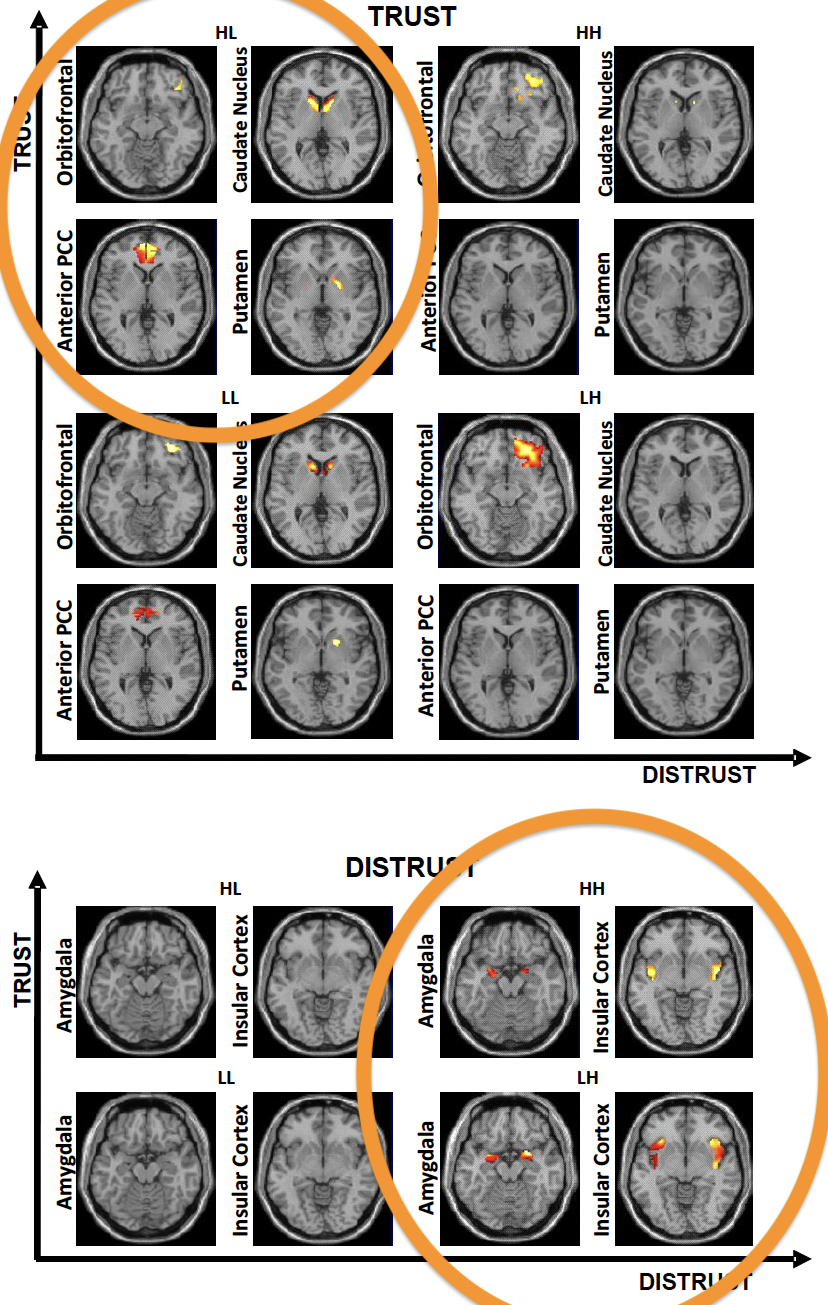
More specifically:
“Trust is associated with the caudate nucleus and putamen that jointly constitute the dorsal striatum, an area associated with reward prediction (…) While both areas are part of the reward brain that receives dopaminergic input from the midbrain, they have distinct functions. The caudate nucleus is involved in comparing actual and expected rewards and is activated proportionately to the magnitude of the expected reward, while the putamen is involved in evaluating rewards to make predictions. Thus, these two areas work together to compare and evaluate the potential gains of trust to guide behaviour (…) This result implies that the expected rewards of trust are not only associated with economic rewards, but also with social rewards linked to the seller’s expected goodwill.”
In turn, “Distrust is associated with the amygdala, a critical area triggered by intense and sudden emotional states, particularly negative ones (…) Amygdala activation tends to be abrupt and short-lived to enable quick retreat to prevent harm from a potentially injurious situation, consistent with the view of distrust that stresses vigilance against danger (…) (Moreover), distrust is associated with the insular cortex, another primary sensory cortex for visceral information and autonomic arousal. While the insular cortex is also triggered by intense negative emotions, its primary focus is the fear and anticipation of losses. (…) The insular cortex is activated by discredibility (fear of economic loss) and malevolence (fear of social harm).” (pp 389-90).
What this all means is that, if we are looking at customers’ attitudes towards a product (for instance, Generative AI), we need to distinguish between whether customers have trust or distrust, because that will have implications in terms of how they will behave and, thus, what we should do.

If customers have low trust towards Generative AI, it means that they calculate that using the tool will deliver few economic or social rewards. For instance, customers may expect the tool to malfunction, based of not understanding how the tool works. Or, say, customers may know that others disapprove of the use of the tool and will punish them for using it, if they are found out. In this scenario, the perceived net benefit of using the tool is negative.
To increase trust, we would put forward data (e.g., performance statistics) and arguments based on reason (e.g., information about how the product works and produces outcomes A or B).
If, instead of having low trust, customers have high distrust towards Generative AI, then that means that they feel (rather than calculate) that the tool will deliver harmful results (rather than fail to deliver positive results). They may reject the product because, for instance, they dislike big corporations, they got a “bad vibe” about the product, or simply out of principle.
To reduce distrust, we would use signalling such as calling our company “open” or “clean”, we might co-brand our product with a trusted partner (e.g., NHS, in the UK) or use imagery such as locks. Alternatively, we might use a descriptive norm (as the one my cleaner used), showing (or suggesting) that the product is widely adopted by the customers’ reference group.
In summary, if you are considering studying what customers think about your product or brand, make sure to check for trust as well as distrust, and adjust your actions accordingly.

 Ana Canhoto