
We know from personal experience that digital technology can shape our wellbeing. On the one hand, it offers speed, convenience, and greater access to services. On the other hand, it can feel cold, confusing, or even overwhelming — especially for people facing challenging life circumstances.
What’s less clear, however, is why the same technology can sometimes help and sometimes hinder. Why does a chatbot, app, or website work smoothly for one user, yet leave another feeling excluded or stuck? And why might even the same user have a positive experience in one situation, but a negative one in another?

To better understand this, Danae Manika, Emma Wainwright, Donna-Marie Holder and I looked beyond the technology itself and considered two other elements: the user, and the use.
Drawing on data from interviews, observations and document analysis, we examined how residents in a region of England interacted with the digital services provided by the local authority. We focused particularly on the resources used during those interactions and the kind of tasks that they were trying to complete.
Regarding resources, we draw on the conversation of resources theory, distinguishing between internal vs external, and between tangible vs intangible.
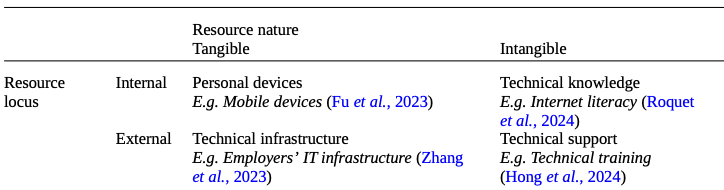
As for type of task, we draw on involvement theory, distinguishing between:
- Low involvement tasks – defined as habitual or low-cost decisions that have little importance or risk for consumers
- High involvement tasks – defined as decisions that carry high risk, because they are expensive or happen irregularly
Key findings
Our research showed that digital wellbeing is shaped by the interaction between the technology, the user, and the nature of the task.
Namely, for low-involvement tasks such as paying a bill or checking a bin collection date, people welcomed digital options provided that the information was clear and the system worked as expected. They experienced positive digital wellbeing in the form of: convenience, time savings, and a sense of control.
But, for high-involvement tasks (like resolving a housing dispute or dealing with community safety issues) the key was that systems provided continuity, and support.

Conversely, digital feature that results in errors or lack of resolution caused reduction in digital wellbeing for high-involvement tasks. For low involvement tasks a key problem was the high cognitive load experienced when interacting with some technologies

What does this mean for managers?
Technology doesn’t operate in a vacuum — and neither do users. By paying attention to the context of use, and by designing with both task complexity and human variability in mind, we can better support digital wellbeing across public services and beyond.
Our research is directly relevant to managers in public services, such as healthcare providers, housing associations, job centres and schools, as in these contexts there is an explicit mandate to be inclusive and improve their constituents’ wellbeing.
However, more broadly the research is relevant to any organisation that uses digital technology to deliver both routine and emotionally high-stakes interactions. The key message is that those organisations need systems that flex around users’ needs. So, when developing digital tools, they need to ask:
- What kind of task (high vs low involvement) will this technology be supporting?
- What resources (technological, cognitive, emotional) do the users of this technology have?
- Does the technology support those tasks, without depleting those resources?
If the answer is no, it’s time to re-design.
The details for this paper are:
Canhoto, A.I., Manika, D., Wainwright, E. & Holder, D.-M. (2025), The impact of technology: how features, resources and task demands shape digital well-being. Information Technology & People, Vol. ahead-of-print No. ahead-of-print. https://doi.org/10.1108/ITP-01-2024-0077
It was published here. And you can find an open access version here.
For you, what makes the difference between having an empowering vs exhausting digital experience?

 Ana Canhoto
3 thoughts on “New paper: How features, resources and task demands shape digital wellbeing (or why digital technology helps some people some times, but not everybody all of the time)”