
We naturally assume that negative customer emotions result in negative outcomes for a business. Fear, for instance, leads to avoidance, while anger leads to negative word of mouth. However, according to a study by Anne-Madeleine Kranzbühler, Alfred Zerres, Mirella H. P. Kleijnen and Peeter W. J. Verlegh, there is a negative customer emotion that, under specific circumstances, can result in a positive outcome: guilt.
Kranzbühler and colleagues conducted a meta-analysis of 10 different emotions on three core categories of firm-relevant outcomes: customer evaluations, purchase, and sharing (e.g., word-of-mouth). The results are reported in the paper “Beyond valence: a meta-analysis of discrete emotions in firm-customer encounters”, published in the Journal of the Academy of Marketing Science.
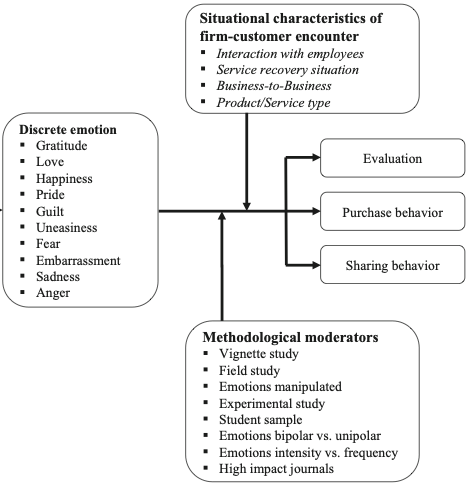
One the emotions that Kranzbühler and colleagues studied was guilt, a negative emotion that occurs when customers believe that their own actions have caused a failure. It is different from embarrassment, in that when someone experiences guilt, they also believe that they have done something morally wrong or unfair to the other party.
So, how can a negative feeling like guilt benefit business?
When a customer experiences personal guilt, they feel a psychological urge to alleviate their internal discomfort, and, consequently, they engage in positive word-of-mouth and other supportive actions toward the firm. Specifically, the authors found an effect size of 0.365 when the firm-customer encounter involves direct interaction with employees. However, and very importantly, if there is no employee interaction involved (e.g., using a chatbot instead, or an online form), that positive effect completely evaporates, dropping to a non-significant 0.030.
The key takeaway here is that human touchpoints are vital when customers make a mistake, such as missing an appointment or damaging a rental item. By having an employee handle the situation, as opposed to an automated system, the business creates a psychological bridge to turn their internal guilt into positive word-of-mouth for the brand.
When was the last time a company’s employee handled one of your mistakes so gracefully that you went out of your way to recommend them to others?


