One of my pet peeves is to hear people use the broad term “marketing” to refer specifically to “advertising”. They will say thinks like “I don’t do marketing” when what they mean is that they don’t do paid advertising. If they have a product or service, if they devise a price strategy, or consider how to distribute their product… they are doing marketing.
I suppose that computer scientists and others feel the same about the term “Artificial Intelligence” (AI). The term AI can actually refer to technologies that have different characteristics and which work very differently. So, it is not very helpful – or, indeed, wise – to use the generic term AI, when we should be referring to specific types of models or approaches.
With this in mind, I found the article “The Acceleration of Artificial Intelligence: Rethinking Organization and Work in an Era of Rapid Technological Change”, by Dominic Chalmers, Richard Hunt, Stella Pachidi, Kristina Potočnik and David Townsend, published in the Journal of Management Studies, really helpful.
Chalmers and colleagues argue that because AI 1) is not a single object and 2) keeps evolving, different types of AI produce very different outcomes for organisations. And, so, it is important for researchers to be specific about which type of AI they are referring to so that the readers can understand when the findings are relevant for their specific situation.
In the paper, Chalmers and colleagues reflect on the affordances of four different types of AI, and how they impact on organisations. The four types are (pp 294-297):
- Predictive AI: Systems that rely on pattern recognition to forecast outcomes, classify entities, or detect anomalies in large datasets.
- Generative AI: Systems that generate synthetic text, images, code and other multimodal artefacts, shifting attention from the analysis of existing data to the creation of new material.
- Agentic AI: Systems that can break down tasks, invoke external tools such as search functions or code execution environments, retrieve information, and construct multi-step analyses for problem solving.
- Embodied AI: Systems that integrate computational intelligence with physical form.
Because each system has different capabilities, they also have different impact on organisations and raise different managerial questions:
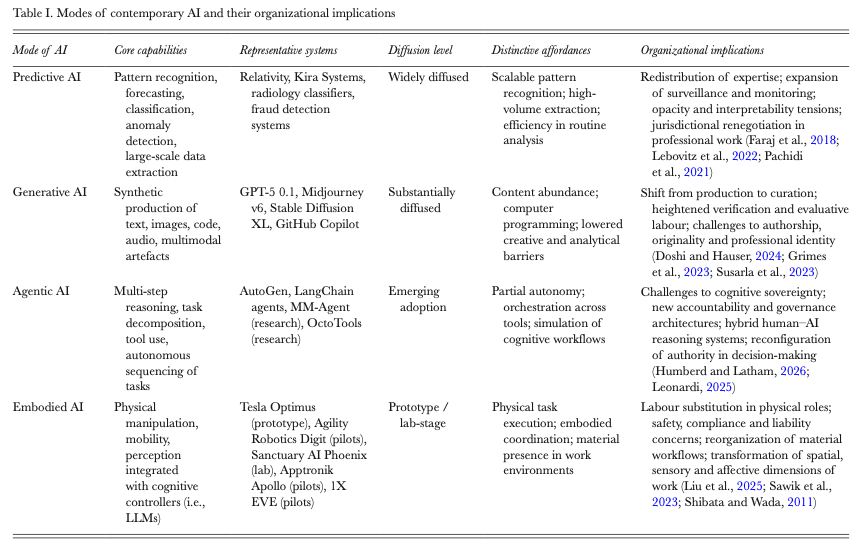
So, a retailer experimenting with predictive AI for demand forecasting is facing very different opportunities and challenges from a law firm deploying generative AI to draft contracts, or a manufacturer introducing autonomous robots in a production line.
Just as saying “marketing” when we actually mean “advertising” obscures important differences, using “AI” as a catch-all term can lead to poor decisions and misplaced expectations. As AI technologies continue to evolve and diversify, we need to become more precise with terminology. So, the next time someone says, “AI increases productivity” or “AI will replace jobs”, turn around and ask “Which type of AI are you talking about?”


