
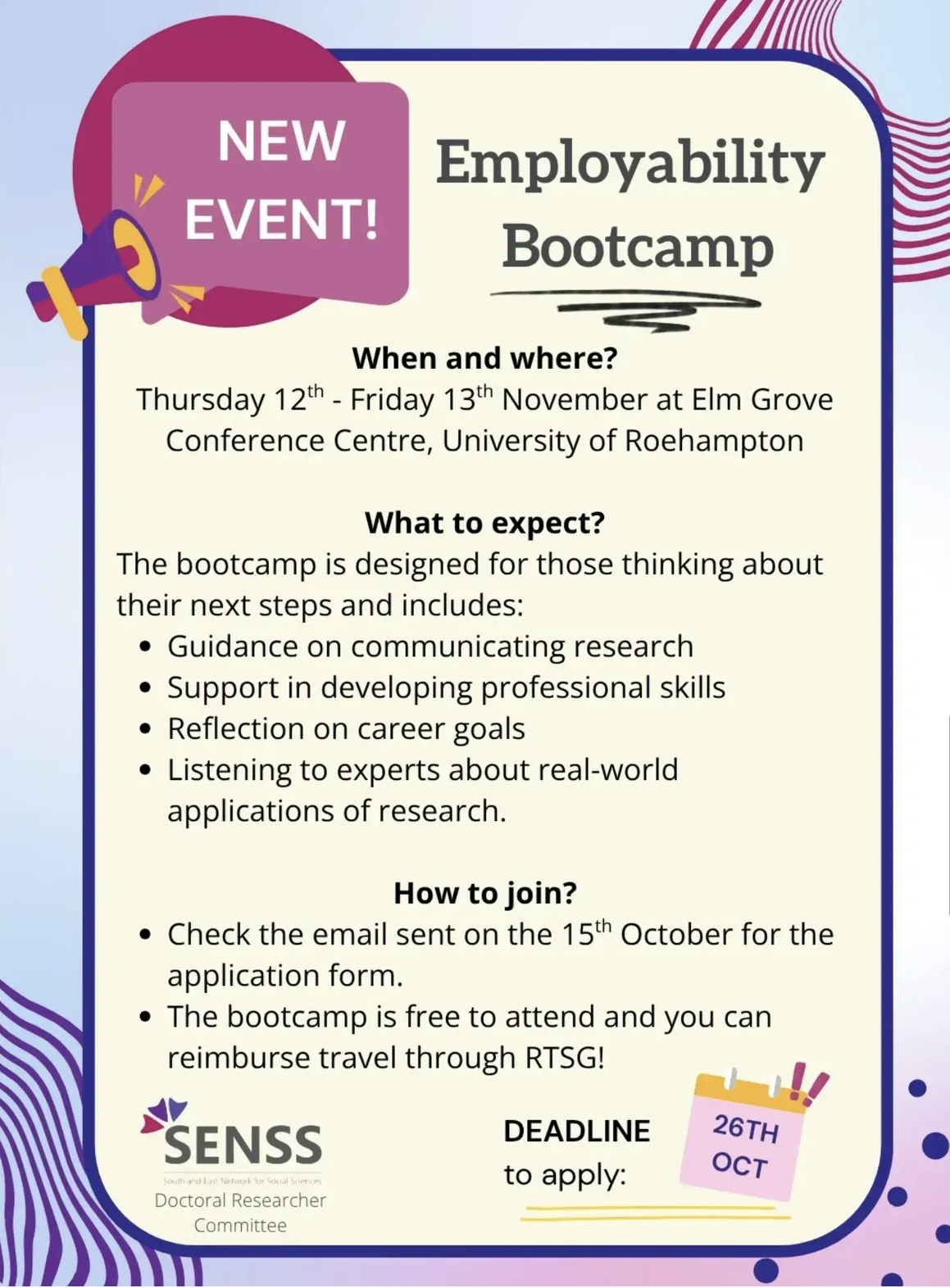
Last week, I attended an employability bootcamp for doctoral researchers. As the name suggests, it was an intensive, focused, hands-on event, aimed at improving doctoral researchers’ confidence and preparedness for the job market. This was my last initiative as Deputy Director for the SeNSS doctoral training partnership, before embracing a new professional challenge.
One of the sessions focused on non-academic careers, and it was delivered by Emily James, from Menzies. In this post, I share three insights that I gathered from that presentation, and which I think are very relevant for anyone considering a transition out of academia (e.g., to a consulting role).
Relevant Skills
A common challenge for PhD graduates and academics is the feeling that all our topic expertise and well-honed research skills are irrelevant for the corporate world.
James, however, urged workshop participants to see their PhD as more than an educational credential, and to frame the experience of completing a PhD as evidence of six key capabilities:
- Complex problem solving: You start with ambiguity and build a route through it
- Evidence & judgement: You assess sources, challenge assumptions and defend conclusions
- Project ownership: You plan long workstreams, manage setbacks and deliver
- Communication: You adapt complex ideas for different audiences
- Resilience: You work through critique, uncertainty and repeated iteration
- Independent learning: You become credible in unfamiliar territory quickly
Non-academic employers heavily rely on behavioural interview questions (e.g., “Tell me about a time when … “). So, candidates should prepare one or two examples for each capability, using specific situations from their doctoral work.
Communicating Your Experience
Employers need to understand not just what researchers have done, but what they can do as a result. So, candidates need to communicate their background and capabilities in ways that allow non-academic hiring managers to immediately recognise the value that these experiences bring to the business. For example, a PhD candidate might have done a literature review to become familiar with the state of knowledge in a particular field; but what matters to an employer is that this person was able to identify relevant sources, synthesise large volumes of text, identify key messages and, then, distil the findings into clear and meaningful conclusions.
James gave examples of how to “translate” academic experience into employer-relevant terms:
| Academic version | Employer version |
| Designed a research methodology | Structured an ambiguous problem and selected a robust approach |
| Literature review | Synthesised large volumes of evidence into clear conclusions |
| Presented at conferences | Communicated complex ideas to specialist and non-specialist audiences |
| Managed fieldwork / participants | Coordinated stakeholders, timelines, risks and competing priorities |
| Responded to peer review | Used challenge and feedback to improve quality under scrutiny |
When preparing a CV and cover letter, for a position outside of academia, researchers need to rewrite their accumulated experience in employer-focused language.
Commercial Awareness
Some researchers worry that moving into a non-academic requires deep knowledge of commercial or financial markets. However, James reassured participants in this employability bootcamp that commercial awareness is not about knowing lots of facts about a particular industry. Rather it is about developing a practical problem-solving mindset.
The key skill, James said, is to understand how analysis informs decisions, and how those decisions are shaped by organisational priorities and constraints. This requires paying attention to the following questions:
- Who? → Who is the client, customer, user or stakeholder?
- Why now? → What changed? What pressure or opportunity exists?
- So what? → What happens if nothing changes?
- Constraints? → Time, cost, regulation, people, risk, reputation?
- Decision? → What does someone actually need to decide or do?
In summary, moving beyond academia does not mean leaving behind the skills and experience developed through research. It means recognising their value in a different context and learning how to communicate that value to people who may not be familiar with academic work. For researchers considering a career beyond academia, the key message is: How could I use what I already know and do in a different setting, and communicate that effectively?


