Earlier this week, I punctuated a message for a colleague with the emoji below:

I wanted to express my frustration at a certain situation, by adding an emoji that, in my view, had a certain physical resemblance to me.
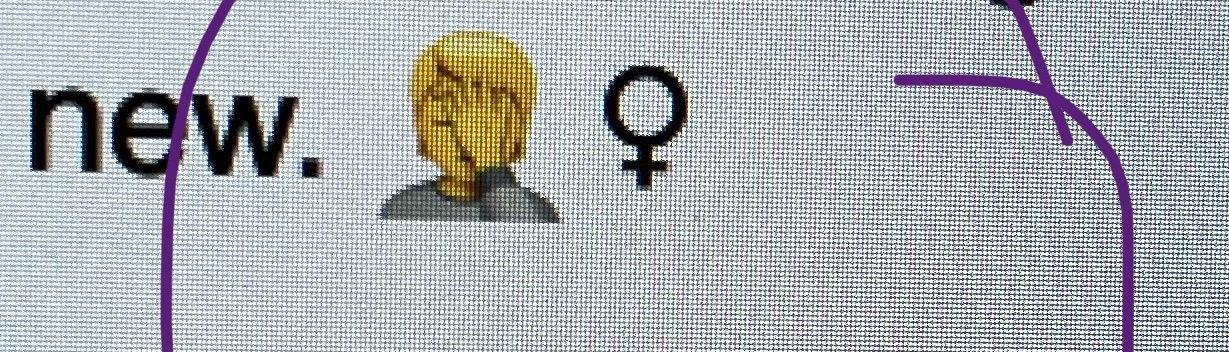
However, something happened between me (the information source) and my colleague (the destination) such that when my colleague received the message, the “Frustrated Ana” depiction had been replaced with something else:
When I mentioned this on social media, friend of the blog Arjan Tupan directed me to a really interesting episode of the “Not Past It” podcast, where this same issue is discussed*.
The episode covers the inception of emojis (remember the emoticons? When we used letters, numbers and punctuation to illustrate emotions – say a colon, plus a dash plus a parenthesis to suggest a smiley face, or an 8 plus a parenthesis to suggest confusion) and how they evolved into the range of characters that we have today, and which continues to grow.
Around minute 10, the episode explains how emojis actually work: The Unicode Consortium sets outs the standards that allow computers to talk with each other through text, across different coding languages, language systems (e.g., Latin vs Arabic) and operating systems. To achieve that, the Consortium gives each character a distinct code – for instance, a specific code which translates hitting a particular key on my computer or phone into the letter A at the other end – such that the message that I send at my end is readable at the other end.
However, as explained at around minute 19, the Consortium’s standards are just guidelines. Ultimately, it is up to the coder, or the company, to decide whether to implement those guidelines or not.
In this case, it looks like my frustrated female emoji was translated into a frustrated non-binary emoji + female icon which, I suppose, is technically close to the originally image. However, pragmatically, it is very different. My Frustrated Ana was lost in emoji translation.
It’s a really interesting episode. Thank you Arjan for the suggestion. I recommend that you give it a listen.
*An example of how social media can be educational

 Ana Canhoto
loved reading this article about the potential pitfalls of using emojis across different cultures. It’s so important to consider the nuances of language and cultural context when communicating with customers. I’ve had to learn the hard way that what might be a harmless emoji in one culture can have a completely different meaning in another. For that reason, I always make sure to double-check the meanings of emojis before using them in my responses. Speaking of which, I’ve found a great resource for emoji meanings and shortcuts at emojicopy.me, which has been super helpful in avoiding any misunderstandings. Has anyone else had any experiences with emojis getting lost in translation?
LikeLike