
I was cleaning my e-mail inbox when I saw this e-mail from Gemini, about a new product feature allowing me to import my chat history from other generative AI apps:
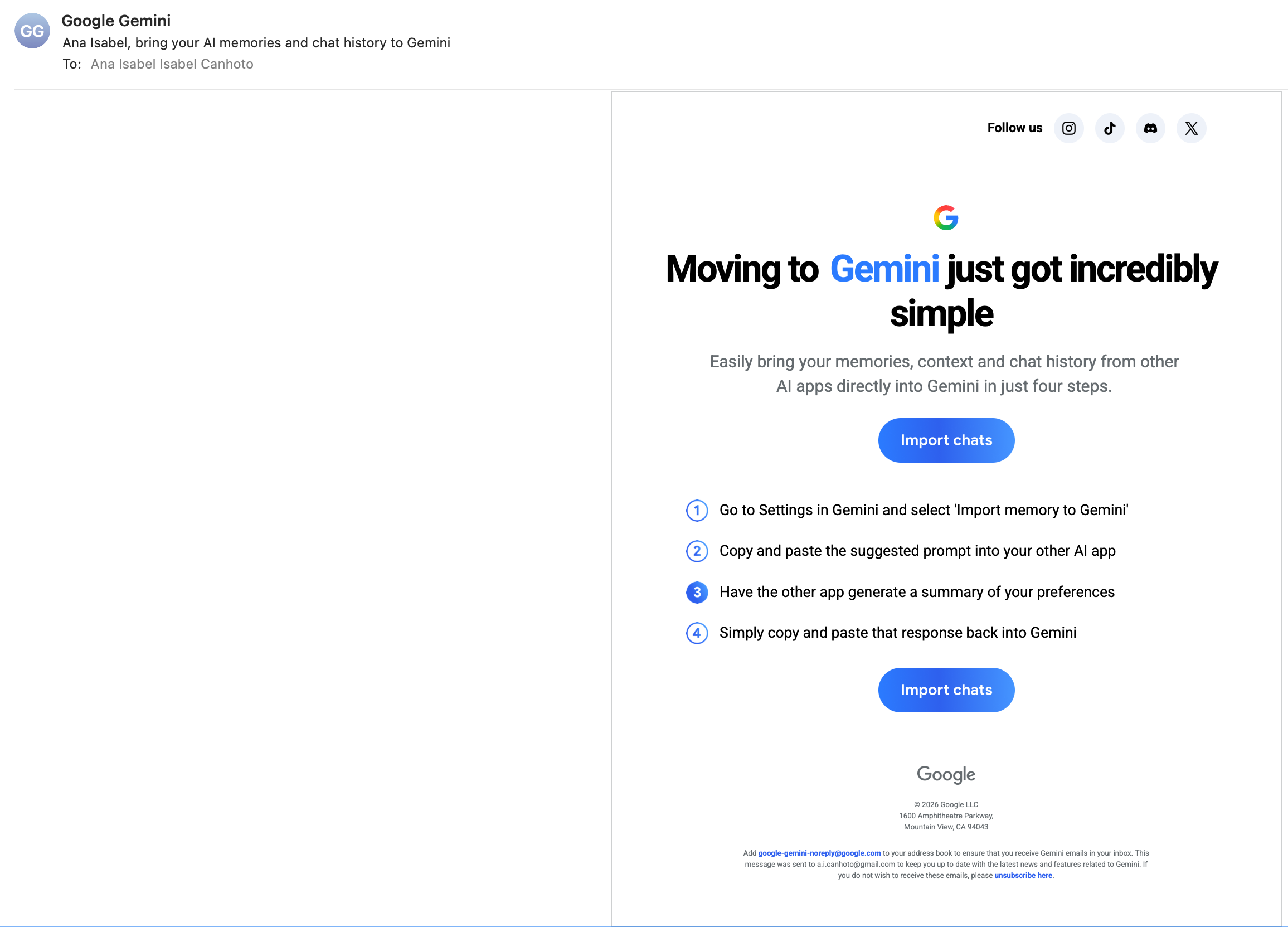
What Gemini is doing here is recognising that the cost of using a certain product is more than the direct cost of that product (e.g., the monthly fee) – it also includes the cost of changing from one provider to another. Hence, the name “switching cost”, for this type of barrier.
Switching costs usually give market pioneers or market leaders an advantage.
For example, in the 1990s, files created in one operating system (Windows) could not be read in the other (Mac OS). Given that people usually started using computers with the Windows operating system in their schools, universities or workplaces, they ended up accumulating files and experience in that system. This gave Microsoft a significant advantage over Apple.
That changed in 2002. Apple launched its famous Switch campaign, consisting of a series of ads emphasising how easy it was to transfer files across the two systems and, more importantly, how much more pleasant it was to use a Mac computer over a PC.
That campaign is credited with starting Apple’s reversal of fortune, subsequently consolidated with the release of the iPod, and setting the stage for Apple’s dominant ecosystem.
For personal computers, the key switching cost was file portability. For Gemini, in the generative AI era, the key switching cost is cognitive and relational. For a certain type of customer, the key factor preventing them from changing from one large language model (LLM) app to another (let’s say, from ChatGPT to Gemini) is the learning and customisation that comes from using the first LLM for a while. An LLM becomes more valuable the more it “knows” you: your style, your custom instructions, your past prompts… People are not necessarily loyal to ChatGPT’s underlying code, nor are they deterred by differences in the unit price. They are loyal to the personalisation resulting from the accumulated interactions with one particular LLM, and they are deterred by the effort required to recreate that with another one.
Google’s new feature isn’t just a cleaver technical import tool; it is a calculated mechanism to destroy the switching-costs experienced by ChatGPT users, and catch up to OpenAI’s first mover advantage.
So, managers need to ask themselves: Are your customers staying with you because your product is genuinely superior, or are you just benefiting from a high switching cost? And, more importantly, what happens to your business the day a competitor builds a bridge that addresses it?


