
The recent report by the Office for Students (OfS) and Advance HE about the use of generative AI in universities spurred a new round of lively discussions in one of my online groups, about the role of this technology in education and research. Let’s just say that, in this group, there are quite different views about whether we should block the use of AI, allow it, encourage it or even require it. At one end, there are those that think that generative AI is destroying critical thinking skills (and, probably, humanity). At the other end, there are those that think that AI is helpful, and that students and researchers need to develop AI-related capabilities. These differences have, at times, led to heated discussions that go beyond the technology, and which touch on much deeper questions about professional identity, values and responsibilities. So, I have been wondering why it is so difficult to navigate discussions about the use of generative AI in a professional setting.
The paper “In artificial intelligence (AI) we (dis)trust? Navigating institutional pressures for automation and augmentation in the implementation of AI in organizations” offers an interesting perspective on these tensions, not just in relation to view of AI but also in terms of how organisations manage competing priorities more generally. It was co-authored by Dimitris Giannitsas, Ruonan Sun and Joao Baptista, and published in the journal Information and Organization.
Different views, different priorities
In their paper, Giannitsas and colleagues examine how an European airline navigated the introduction of AI across three areas of its operations. The authors identified two different, coexisting ways of thinking about the role of AI in organisations.
The first is the instrumental – analytic logic, which emphasises efficiency, consistency, analytical rigour and performance. From this perspective, AI is attractive because it can process large volumes of information, identify patterns and support standardised, data-driven decisions.
The other is the contextual – normative logic, which emphasises situational understanding, professional judgement and the wider consequences of decisions. From this perspective, AI’s efficiency is downplayed because decisions need to make sense in particular contexts and for the people affected by them.
Neither perspective is inherently wrong because organisations need to be efficient and analytically rigorous, but they also need to consider the context in which decisions are made and their wider responsibilities.
Likewise, in the context of higher education and research, those advocating greater use of AI may be concerned about preparing students for a world in which these technologies are increasingly embedded in professional practice. In turn, those resisting it may be concerned about the development of students’ independent thinking, the integrity of assessment, the originality of research and the implications for academic standards. That is, the different views about AI are not simply differences between embracing or resisting this technology. Rather, they reflect different but equally legitimate understandings of what universities do and what responsibilities academics have.
The danger of confusing agreement with alignment
One aspect of the generative AI or no generative AI debate that concerns me is that if people feel that expressing their view will lead to criticism or even punishment, they may just stop doing so. That’s something that the OfS/Advance HE report mentions, too: people may fail to disclose their AI use (and whether it is above or below the relevant rules) because they do not feel safe. If this happens, what looks like consensus about whether or not to use generative AI may be only self-protective behaviour. In the end, the underlying tension remains unsolved; it’s just harder to see that it is still there.
So, how can we navigate competing AI views without becoming paralysed by them?
Giannitsas and colleagues describe two practices that helped the airline manage the tensions associated with AI implementation. The first is mindful evaluation. Rather than treating AI outputs as definitive answers to be accepted or rejected, people approached them as propositions that needed to be examined. They questioned the outputs, considered different criteria and assessed whether the results were appropriate in the circumstances. The second is proactive safeguarding. This involved putting structures and processes in place to ensure that the use of AI remained aligned with organisational priorities and responsibilities. The authors gave examples such as comparing AI outputs with human decisions, testing different scenarios and establishing oversight arrangements.
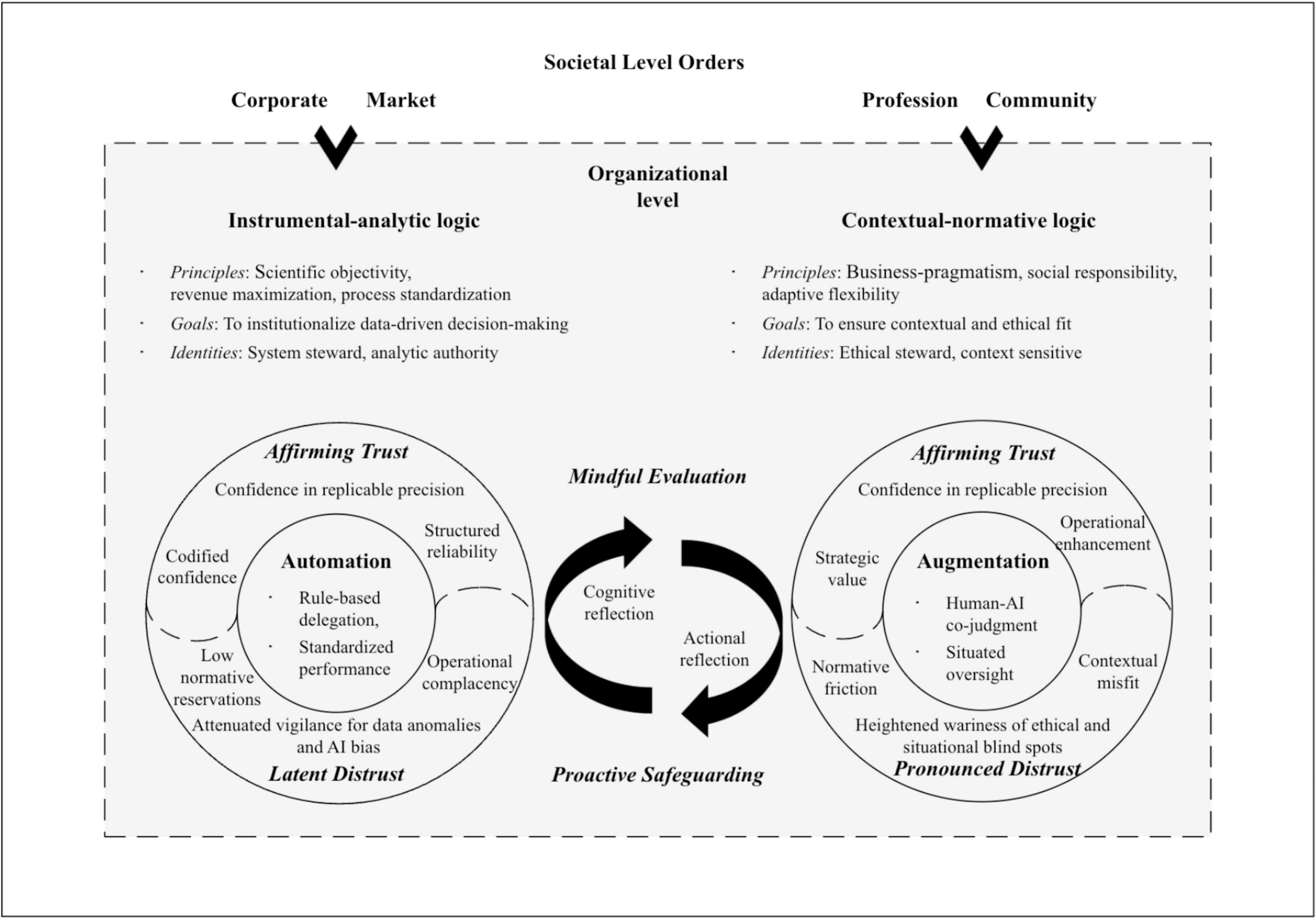
Importantly, neither practice required everyone to have the same level of trust in AI, or to agree on every aspect of its use. Rather, they provided ways of working around the differences arising from having multiple objectives and stakeholders, instead of
pretending that those differences did not exist.
I, too, hope that my online group can become an environment in which all of us can express different views and raise concerns, without being labelled obstructive or, conversely, a sell-out. After all, we do need to have better conversations about what we want AI to do, what we want to preserve, and what responsibilities we have towards others. If you found a productive way of tackling these conversations in your professional network, please share!


